For years, hiring teams have been promised one thing: ‘more automation will fix hiring’. More workflows. More filters. More dashboards. More rules. And yet, despite smarter tools and heavier tech stacks, recruiters are overwhelmed, hiring managers are frustrated, and great candidates are still slipping through the cracks. Candidates who looked perfect on paper fail interviews. Recruiters spend hours inside systems but still rely on gut instinct when it matters most.
The problem isn’t effort.
It isn’t even technology.
The problem is that modern hiring is trying to make decisions using systems that were never designed to think.
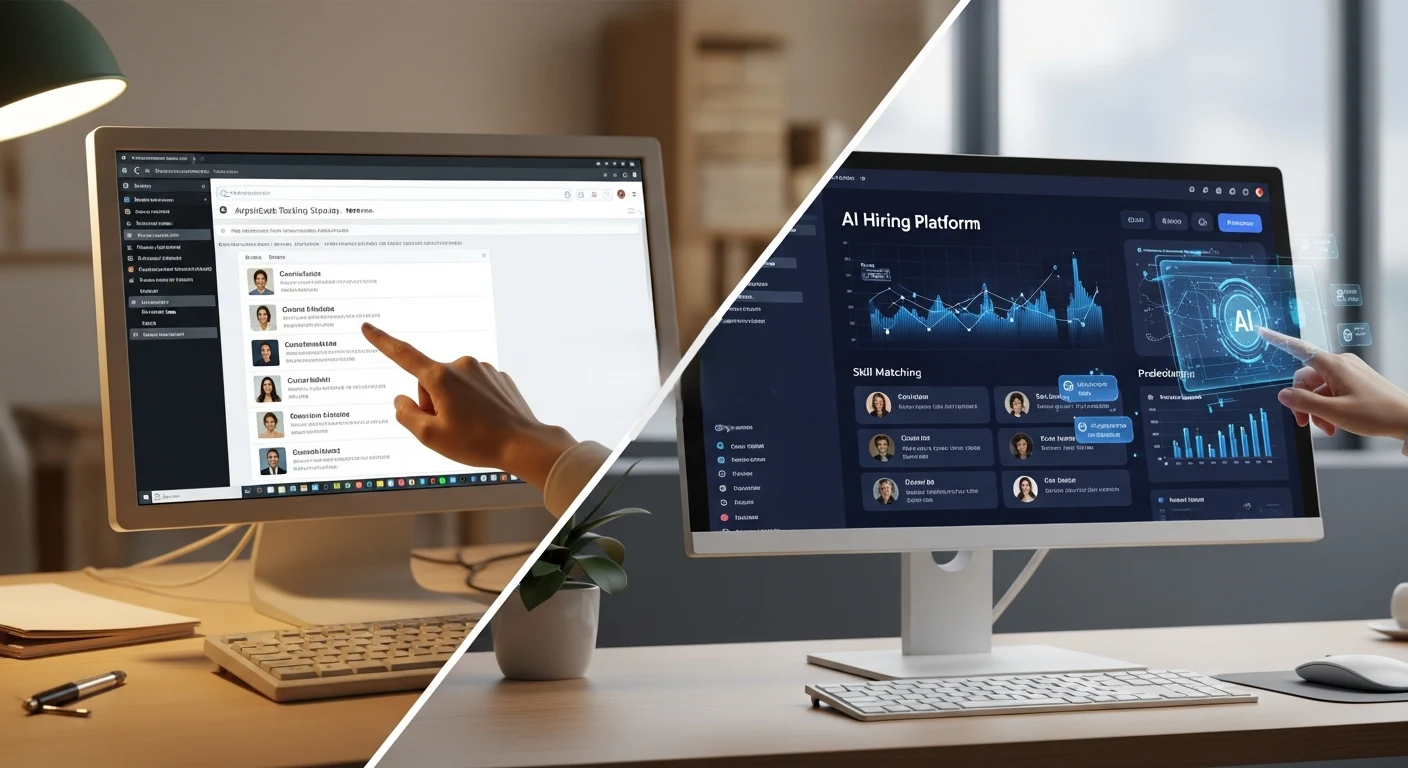
For decades, Applicant Tracking Systems have been positioned as the backbone of recruiting. They organize candidates, standardize workflows, and create operational order. But as hiring has become more complex, more competitive, and more AI-driven, the limits of ATS-centric thinking have become increasingly clear.
What’s missing is a hiring intelligence layer; a decision-support system designed to interpret signals, understand context, and support real decision-making beyond tracking.
How Hiring Systems Reached a Breaking Point
Hiring didn’t become broken overnight. It slowly drifted away from human judgment and toward mechanical processing.
The Original Purpose of ATS Platforms
When ATS platforms first entered the market, their purpose was narrow and practical. They were built for one core job: administration.
Early ATS platforms helped HR teams:
- Store resumes digitally
- Track applicants across stages
- Maintain compliance records
- Reduce email and spreadsheet chaos
At the time, this was transformative. Recruiters finally had visibility into applicants and could report on hiring activity with confidence.
What ATS platforms were never designed to do was evaluate talent. They were never intended to evaluate human potential or guide complex hiring decisions. Their value proposition was simple: keep hiring organized. They were record-keeping systems, not decision engines.
That worked, until hiring itself changed.
Why Tracking Applicants Became the Default Model
As online job portals grew and applying became frictionless, applicant volume exploded. A single role could attract hundreds or thousands of resumes. Under pressure, ATS platforms evolved to handle:
- High application inflow
- Resume parsing
- Status-based workflows
- Keyword filters
Recruiters leaned on filters and keywords simply to survive the volume.
Over time, this shift became normalized. “Tracking” quietly became “screening.” And screening became “decision-making”, even though the underlying logic never changed.
Tracking applicants wasn’t just about organization anymore; it became the primary way decisions were made.
The Growing Disconnect Between Volume and Decision Quality
This is where the model began to fracture. As volume increased, decision quality declined. More applicants didn’t mean better hiring; it meant noisier pipelines and more reliance on crude elimination methods. Hiring systems were optimized for throughput, not judgment. And they were doing their job efficiently, but the outcomes were getting worse. And when decision quality declines, the cost compounds, including bad hires, missed talent, recruiter burnout, and broken trust.
The message was clear: more volume did not mean more value, speed did not mean better thinking, and automation alone did not lead to better hires.
The Limitations of Applicant Tracking Systems in Modern Hiring
ATS platforms still matter, but the limitations of applicant tracking systems are no longer theoretical; they are operational realities.
ATS Platforms Were Built for Tracking, Not Decisions
At their core, ATS platforms operate on structured inputs and predefined logic. They excel at managing stages, statuses, and compliance requirements. They rely on static fields, keyword matches, and binary logic (pass/fail, match/no match). What they lack is the ability to reason.
An ATS doesn’t understand why a candidate changed careers, how adjacent skills translate across industries, or whether a non-traditional background might outperform a “perfect” resume. It sees data fields, not signals.
How Volume-Based Hiring Exposed ATS Limitations
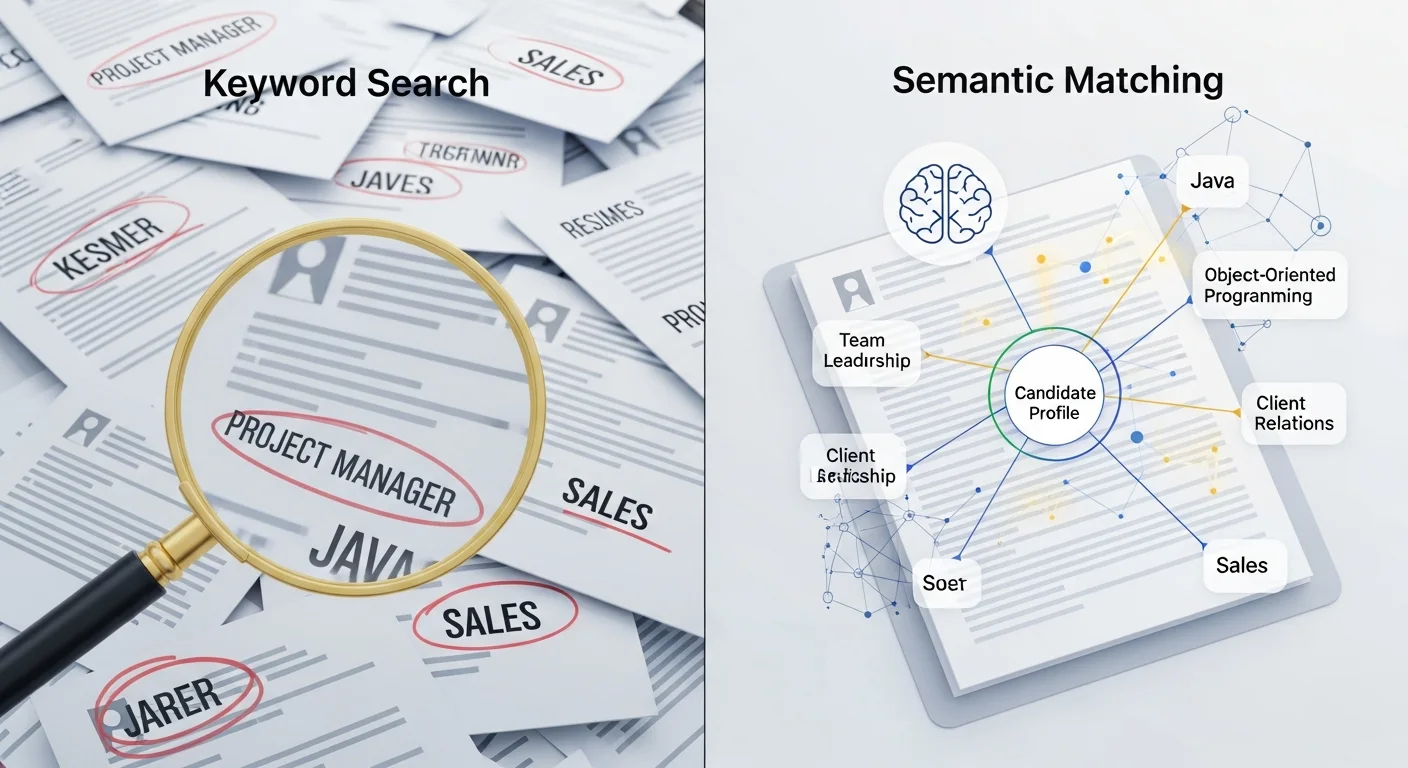
As organizations scaled, ATS-driven screening became increasingly brittle. Keyword-based filtering began excluding strong candidates who didn’t mirror job descriptions word-for-word. Resume formatting started influencing outcomes more than real capability. High-potential profiles get buried under “perfect matches”. Candidates learned how to game the system faster than the system could adapt.
The result wasn’t system failure; it was silent degradation. Hiring looked efficient on paper, while effectiveness steadily declined.
When Workflows Stop Improving Hiring Outcomes
Many teams tried to solve this by adding more workflows. More stages. More automation rules. More rejection logic. No doubt workflows feel productive as they have auto-reject rules, stage automation, and SLA timers. But workflows don’t think. They only execute assumptions.
Without intelligence, a system can’t learn from outcomes, and adding structure just accelerates the wrong decisions.
This becomes clear when you look at how hiring decisions are actually made in practice, especially when resumes are analyzed at scale rather than filtered by static rules.
Why Automation Alone Fails in AI-Driven Hiring Decisions
Automation fails because it executes predefined rules, while hiring decisions require contextual judgment, signal interpretation, and adaptability. AI-driven hiring decisions are often misunderstood. Many systems labeled “AI” are simply automated rule engines operating at scale.
Automation vs Intelligence in Hiring Technology
Let’s clarify the difference:
- Automation executes predefined rules
- Intelligence evaluates context, learns patterns, and adapts decisions
In hiring, this distinction matters enormously. Most hiring tech today automates actions. Very little evaluates outcomes.
True AI-driven hiring decisions require:
- Context awareness
- Multi-signal evaluation
- Continuous learning
An automated system can reject candidates instantly. An intelligent system can explain why a candidate should or shouldn’t be prioritized.
Why Efficiency Metrics Don’t Equal Decision Quality
Time-to-fill and pipeline velocity are easy to measure, which is why they dominate dashboards. A fast hire who churns in six months is not a win. These systems say nothing about long-term success. They don’t measure:
- Missed talent
- False rejections
- Long-term performance
- Team impact
True AI-driven hiring decisions consider downstream impact, performance, retention, and team fit, not just operational efficiency.
Where Automated Systems Silently Fail Recruiters
The most dangerous failures are invisible ones. Automation fails quietly when: Candidates are rejected for surface mismatches, non-linear career paths are penalized, diversity pipelines are narrowed down unintentionally, candidates are rejected without review, and biases are reinforced through historical data. Recruiters forced to override systems manually because “something feels off.”
Automation doesn’t fail loudly. It fails quietly and repeatedly. Much of this failure stems from keyword-based screening limitations, where resumes are evaluated for visibility rather than relevance.
Why Most “AI Hiring Tools” Are Still Just Automation
Many hiring tools marketed as “AI-powered” are, in reality, sophisticated automation layers built on top of traditional rule-based logic. They accelerate actions; sorting, rejecting, routing, but they do not fundamentally change how decisions are made. These systems execute predefined assumptions at scale rather than interpreting context or learning from outcomes. As a result, speed increases, but judgment does not. This distinction matters because hiring is not an execution problem; it is a decision problem. Without intelligence, automation simply scales the same limitations faster, reinforcing patterns that already fail to identify the best talent.
The Hidden Cost of ATS-Driven Hiring
The real cost of ATS-led hiring doesn’t show up immediately, but it compounds fast.
False Negatives and Missed Talent
Every filtering system creates false negatives. In hiring, those false negatives are people, often the very candidates organizations claim they want. High-potential, diverse, and unconventional talent is routinely filtered out, adjacent skills are ignored, and growth potential is overlooked before a human ever engages.
Every false negative is a lost opportunity that competitors may capture.
Resume Keyword Gaming
Candidates adapt faster than systems. Today’s resumes are engineered by keyword stuffing, inflated skill claims, and generic formatting to pass filters, not reflect reality. This creates a market where optimization beats authenticity, and hiring teams spend more time validating resumes than evaluating people.
Recruiter Burnout Masked as “Process”
Recruiters are expected to trust systems while simultaneously correcting them. Recruiters didn’t sign up to manage filters and clean data.
Yet many spend their time manually reviewing ATS rejects, overriding automation, and explaining system decisions to hiring managers
This contradiction leads to burnout. When professionals are reduced to babysitting software, morale suffers, and judgment degrades. And it isn’t a people problem, it’s a system design failure.
Why These Costs Don’t Show Up on Dashboards
The most damaging consequences of ATS-driven hiring rarely appear in standard hiring metrics. Dashboards track time-to-fill, pipeline volume, and stage conversion rates, but they do not capture missed potential, false rejections, or long-term performance outcomes. When strong candidates are filtered out early, there is no alert. When recruiters override systems repeatedly, the effort is invisible. When teams settle for “good enough” hires due to decision fatigue, the cost emerges months later as churn or underperformance. These hidden costs accumulate quietly, making hiring appear efficient while eroding effectiveness beneath the surface.
What a Hiring Intelligence Layer Actually Means
A hiring intelligence layer is a decision-support system that sits above the ATS, analyzing contextual signals, candidate behavior, and role requirements to guide smarter, evidence-based hiring decisions
This is not just another tool meant to replace existing systems. It’s a new decision framework.
Context-Aware Candidate Evaluation
An intelligence layer understands candidates in context. It evaluates experience relative to role requirements, interprets career progression, and weighs transferable skills. Instead of asking “does this resume match,” it asks “does this person make sense for this role.”
Signal-Based Hiring Decisions Over Keyword Filtering
Rather than relying on static keywords, intelligence layers use signals, interview performance, behavioral indicators, skill application, cross-role skill mapping, and learning patterns. Decisions become probabilistic and explainable, not binary and opaque.
How Intelligence Layers Evolve Hiring Technology
An intelligence layer integrates with existing ATS infrastructure, learns from hiring outcomes, and continuously refines decision logic.
They adapt to changing role requirements, market conditions, and team dynamics. Hiring technology finally starts to behave like a decision system, not a filing cabinet. The ATS remains the system of record, and the intelligence layer becomes the system of judgment.
How to Explain a Hiring Intelligence Layer to a CTO
Think of the ATS as a database and workflow engine. An intelligence layer is the reasoning engine on top of it, similar to how analytics sits on top of raw data. It doesn’t replace or replicate the infrastructure; it makes sense of it.
How Hiring Intelligence Changes Business Outcomes
When intelligence enters hiring, the impact is immediate and measurable. Decisions improve, everything downstream improves.
Faster, More Confident Decisions
Recruiters stop second-guessing filters and start trusting insights. Recruiters spend less time screening and more time deciding. Hiring managers gain clarity; they see a clear rationale behind recommendations, comparable candidate insights, and reduced decision fatigue instead of confusion. Decisions move faster because they’re grounded in evidence, not volume.
Higher Quality-of-Hire
By prioritizing signal strength over resume similarity, organizations see better role alignment, faster ramp-up, stronger performance, and lower early attrition. Hiring becomes predictive rather than reactive.
Reduced Dependency on Manual Screening
With intelligence guiding evaluation and automation handling execution, manual screening becomes the exception, not the norm. Recruiters focus on meaningful work that builds relationships, aligns stakeholders, develops talent strategies, and prioritizes good judgment instead of just handling immediate tasks.
Why Better Decisions Cascade Across the Organization
Hiring decisions do not exist in isolation; they ripple outward across teams and time. When decisions are clearer and better informed, managers spend less time correcting misalignment, teams ramp faster, and trust in the hiring process increases. Strong early decisions reduce downstream friction, fewer performance issues, fewer rehires, and less organizational drag. Over time, this compounds into a measurable advantage: teams become more resilient, leadership spends less time managing talent risk, and hiring shifts from a reactive function to a strategic capability. Organizations unlock faster hiring as a competitive advantage, not just operational efficiency. Intelligence in hiring doesn’t just improve recruitment; it improves how the entire organization operates.
How AICRUIT Delivers Hiring Intelligence in Practice
AICRUIT was built to address exactly this gap. Instead of replacing ATS platforms.
Intelligence, Not Just Automation
AICRUIT introduces an intelligence layer that works alongside them. It evaluates candidates through AI-powered screening and interviews, surfaces contextual insights, and supports recruiters with explainable recommendations. Decisions become transparent, not black-boxed.
From Screening to Strategic Hiring
With AICRUIT, teams move from:
- Resume-first evaluation → Signal-first evaluation
- Manual screening → AI-assisted decision support
- Volume management → Quality optimization
This is intelligence-led hiring in action, achieved without disrupting the existing infrastructure.
The Future of Hiring Technology
The direction of hiring technology is clear, and it is not reversible. As talent markets become more competitive and application volumes continue to rise, traditional hiring systems are reaching their limits. What lies ahead is not the replacement of existing tools, but a fundamental shift in how hiring decisions are made.
ATS as Infrastructure, Not Intelligence
ATS platforms will remain foundational. They are not disappearing. They will continue to play a critical operational role across organizations. ATS platforms are well-suited for compliance management, workflow coordination, and secure data storage. They are foundations, not brains.
However, ATS systems were never designed to evaluate talent deeply or improve decision quality. They move candidates through stages, but they do not understand outcomes. As a result, they function as foundations rather than decision engines. In the future hiring stack, ATS platforms will remain essential but firmly positioned as infrastructure, not intelligence.
AI-Driven Hiring Decisions as the New Standard
The next generation of hiring systems will be defined by intelligence layers built on top of existing ATS platforms. These systems will analyze patterns across hiring outcomes, not just resumes. They will learn which candidates succeed, which signals matter over time, and how market conditions affect talent availability. Organizations that adopt it will hire better, faster, and more confidently.
Recruiters as Decision Owners, Not Screeners
As hiring technology evolves, so will the role of the recruiter. Recruiters will move away from being resume screeners and gatekeepers of volume. Instead, they will act as decision owners who guide hiring outcomes with confidence. Technology will finally support recruiters instead of constraining them. Judgment returns to humans, backed by intelligence.
Why Hiring Intelligence Layers Will Define Modern Teams
They will be able to hire faster without sacrificing quality, because speed will be informed by insight rather than shortcuts. These teams will compete more effectively for top talent by making better decisions earlier in the funnel. Over time, they will build more resilient, high-performing teams that adapt to change.
In contrast, organizations that do not evolve will still automate, but they will automate inefficiency. Scaling outdated processes with more technology will not fix poor decision-making. It will only make the consequences arrive faster.
Conclusion: The Future Belongs to Intelligence-Led Hiring Systems
Hiring does not fail because teams lack tools. It fails because most systems lack judgment. Automation without intelligence simply scales mistakes faster. Tracking candidates without context creates blind spots that hide potential and amplify bias. As application volume grows, these weaknesses become structural, not incidental.
The future of hiring technology is not about replacing ATS platforms. It is about acknowledging what they were never built to do. ATS systems excel at managing process, compliance, and data flow. They do not evaluate outcomes, learn from decisions, or adapt to changing talent markets.
Modern organizations are shifting toward hiring as a decision system, not a processing pipeline. This shift prioritizes insight over speed, context over keywords, and learning over static rules. Companies that adopt this mindset will define the next era of talent acquisition. Those who delay will find it increasingly difficult to compete in an intelligence-driven hiring landscape.
The next phase of hiring belongs to intelligence-led systems that respect complexity and strengthen human judgment rather than replace it. These systems surface patterns, highlight risk, and support better decisions at scale. They turn hiring from reactive filtering into a proactive strategy.
A hiring intelligence layer is no longer optional. It is the strategic upgrade of modern hiring demands.
If your ATS manages hiring but doesn’t improve decision quality, the next step is transitioning from ATS-centric hiring toward AI-supported decision models.
Learn how intelligence layers are being applied in a real hiring system
FAQs: Hiring Intelligence & Modern Recruiting
Q: What problem does a hiring intelligence layer solve?
A hiring intelligence layer solves the gap between applicant tracking and decision-making by evaluating contextual signals instead of relying on keyword-based screening.
Q: Is a hiring intelligence layer the same as AI hiring automation?
No. AI hiring automation focuses on execution and efficiency, while a hiring intelligence layer focuses on decision quality and contextual evaluation.
Q: Will AI-driven hiring decisions replace recruiters?
No. Hiring intelligence systems support recruiters by providing insights, not by removing human judgment.
Q: Can a hiring intelligence layer replace an ATS?
No. It complements the ATS by adding decision intelligence while the ATS handles infrastructure.
Q: Is AI-driven hiring reliable?
When designed for transparency and context, yes. Intelligence layers enhance human judgment rather than replacing it.
Q: How does AICRUIT fit into existing hiring stacks?
AICRUIT integrates alongside ATS platforms to deliver AI-powered evaluation and interview intelligence.
Q: Is a hiring intelligence layer relevant for small or mid-sized teams?
Hiring intelligence layers are valuable for any team dealing with resume volume, inconsistent screening, or fast growth. Intelligence improves decisions regardless of company size.