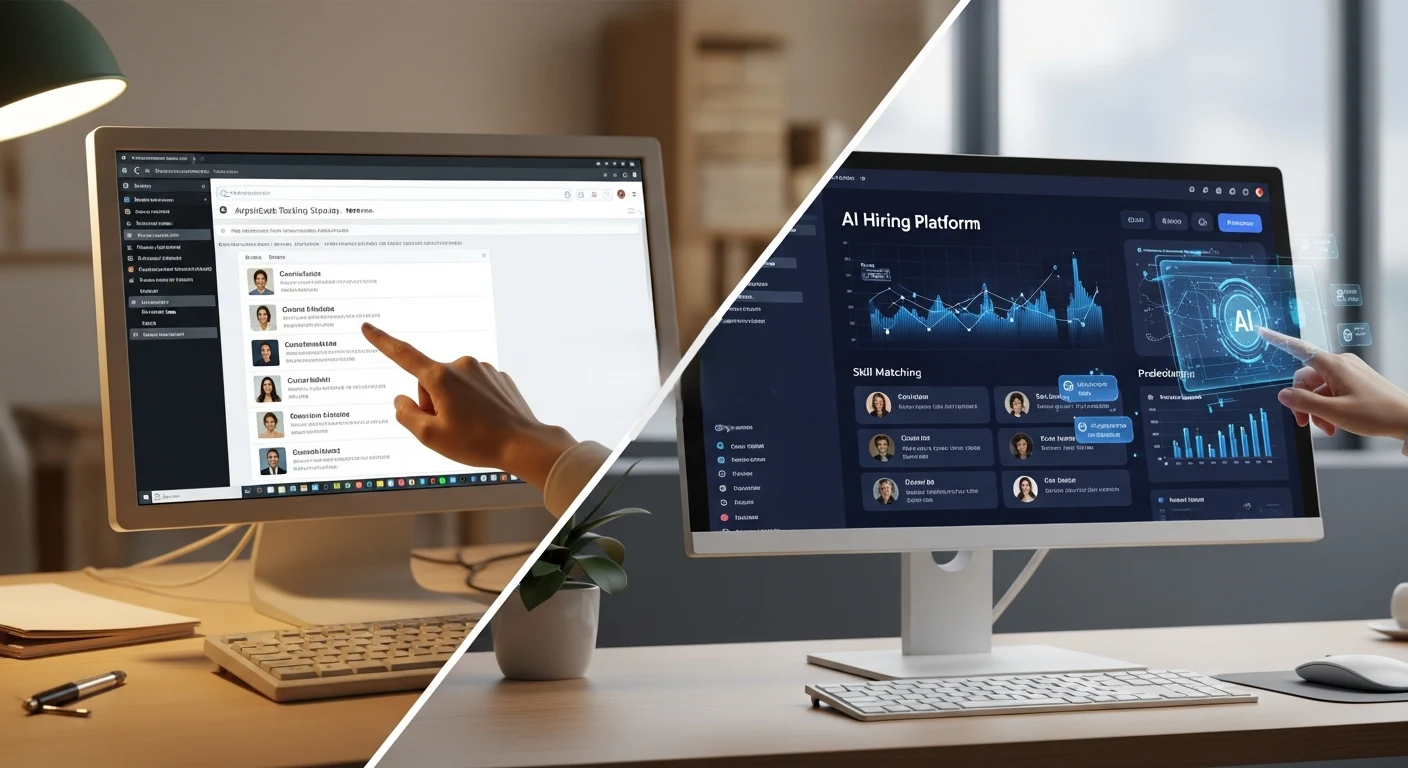
The transition from ATS to AI hiring didn’t start because applicant tracking systems failed. It started because recruiters realized that managing hiring processes is not the same as improving hiring decisions. For years, teams were told that mastering their ATS, adding more filters, more workflows, and more automation would finally make hiring feel under control.
And to be fair, it did bring order. ATS platforms helped teams track candidates, stay compliant, and scale operations. But what many recruiters now admit, often quietly, is that the ATS organized hiring without making it smarter. It streamlined movement through the funnel, not the quality of the decisions made inside it.
Today, more teams are embracing the transition from ATS to AI hiring because hiring itself has fundamentally changed, from linear career paths to more complex, signal-driven decisions. Candidate volume has exploded, but career paths have become less linear. Job titles no longer tell the full story. Skills transfer across roles and industries. At the same time, hiring speed, fairness, and accuracy matter more than ever. Every decision carries a higher impact and a higher cost when it’s wrong.
This guide isn’t about replacing your ATS or introducing black-box automation. It’s about understanding how AI adds decision intelligence to modern recruiting, helping recruiters surface relevance earlier, reduce screening noise, and make better calls with confidence. Most importantly, it’s about making this shift without losing control, trust, or human judgment.
Because the future of hiring isn’t automated decision-making, it’s intelligent, human-led hiring, supported by systems that understand people, not just processes.
Why Recruiters Are Reconsidering ATS-Centered Hiring
Most recruiters don’t wake up wanting new tools. They start questioning the ATS model because, over time, the day-to-day reality of hiring stops making sense. The work feels heavier, decisions feel harder, and outcomes don’t improve, even as processes become more automated.
What’s driving this shift isn’t frustration with recruiters or lack of effort. It’s a growing mismatch between how ATS systems were designed and how hiring actually works today.
Resume Overload and Inefficiency
Recruiters today are drowning in resumes. Industry data consistently shows that a single open role can attract 200–300 applicants on average, and for well-known companies or remote roles, that number often climbs into the thousands.
Even with ATS filters in place, the workload doesn’t disappear; it just changes shape. Recruiters still spend hours reviewing resumes, trying to separate “maybe” from “not relevant,” often under time pressure and with limited context. Research has shown that recruiters spend only a few seconds per resume during initial screening, not because they want to rush, but because volume leaves no alternative.
The ATS helps manage volume, but it doesn’t reduce noise. It organizes resumes, but it doesn’t tell recruiters which ones deserve attention. Over time, speed becomes the priority, not because recruiters value speed over quality, but because the system demands it.
The result is a constant tension between moving fast and deciding well.
Inconsistent Screening Outcomes
Resume screening is far more subjective than most organizations realize. Ask two recruiters to screen the same set of resumes on different days, and you’ll often get different outcomes. Fatigue, urgency, role pressure, and even calendar load influence decisions.
Studies in hiring and organizational behavior have shown that human screening decisions vary significantly under time pressure, especially during high-volume review. The ATS does not resolve this inconsistency. It simply enforces static rules.
When those rules don’t reflect real-world hiring needs, recruiters compensate manually, overriding filters, re-checking rejected resumes, or relying on intuition. Ironically, this creates even more inconsistency, not less.
Instead of supporting judgment, the system forces recruiters to work around it.
Why ATS Alone No Longer Scales
ATS platforms were built to track applicants, ensure compliance, and manage workflows. They were not built to interpret careers.
As a result, they struggle with:
- Non-linear career paths, such as career switchers or returners
- Transferable skills, where experience applies across roles or industries
- Context behind job titles, which vary widely between companies
Research has repeatedly shown that a large percentage of qualified candidates are filtered out early by rule-based screening, not because they lack ability, but because they don’t match rigid criteria.
As hiring complexity increases, ATS-only hiring begins to feel rigid rather than reliable. The system does what it was designed to do, but hiring has outgrown those design assumptions.
This is why recruiters aren’t abandoning ATS platforms. They’re reconsidering what role those platforms should play, and where hiring needs an intelligence layer beyond the ATS.
Redefining the Recruiter’s Role in AI Hiring
One fear comes up again and again when teams discuss AI hiring:
“If AI is involved, what happens to the recruiter?”
The answer is not replacement. It’s elevation.
As hiring volumes increase and decisions become more complex, the recruiter’s role becomes more important, not less. What changes is where recruiters spend their time and how their judgment is applied.
From Screener to Decision Steward
In traditional hiring, recruiters spend a significant portion of their day screening and filtering resumes. Studies and industry surveys consistently show that recruiters spend 30–50% of their time reviewing resumes and managing early-stage screening.
In AI hiring, the work shifts.
AI handles pattern recognition, consistency, and scale. Recruiters focus on decision stewardship, making sure the right candidates move forward for the right reasons.
Instead of asking, “Does this resume match the job description?” recruiters begin asking a more meaningful question:
“Does this candidate make sense for this role and team?”
This shift improves both speed and decision quality because recruiters are no longer buried in volume, they’re focused on judgment.
Where Human Judgment Matters Most
AI is strong at identifying patterns across large datasets. Humans are strong at understanding nuance, context, and intent.
Human judgment remains essential when:
- A candidate has a career break or return-to-work story
- Experience doesn’t follow a standard or linear path
- Cultural fit, team dynamics, or growth potential matter deeply
Research into hiring outcomes repeatedly shows that contextual factors, not just resume similarity, strongly influence long-term success. AI supports these decisions by surfacing insights, but it does not replace them.
The recruiter becomes the final interpreter, not the manual processor.
Oversight Instead of Execution
In AI hiring, recruiters move from executing every step to overseeing the system.
They review AI insights, challenge outputs when needed, and apply judgment where nuance matters most. Instead of manually re-screening hundreds of resumes, they supervise how decisions are being shaped.
This shift has a real impact. Recruiter burnout is a well-documented issue, with workload and repetitive screening cited as leading causes. By reducing low-value manual work, AI-supported hiring helps recruiters focus on higher-impact decisions, reducing fatigue and increasing job satisfaction.
How Recruiters Use AI Tools in Modern Hiring
AI hiring isn’t a black box. When implemented correctly, it’s transparent, collaborative, and recruiter-led.
AI-Assisted Resume Screening
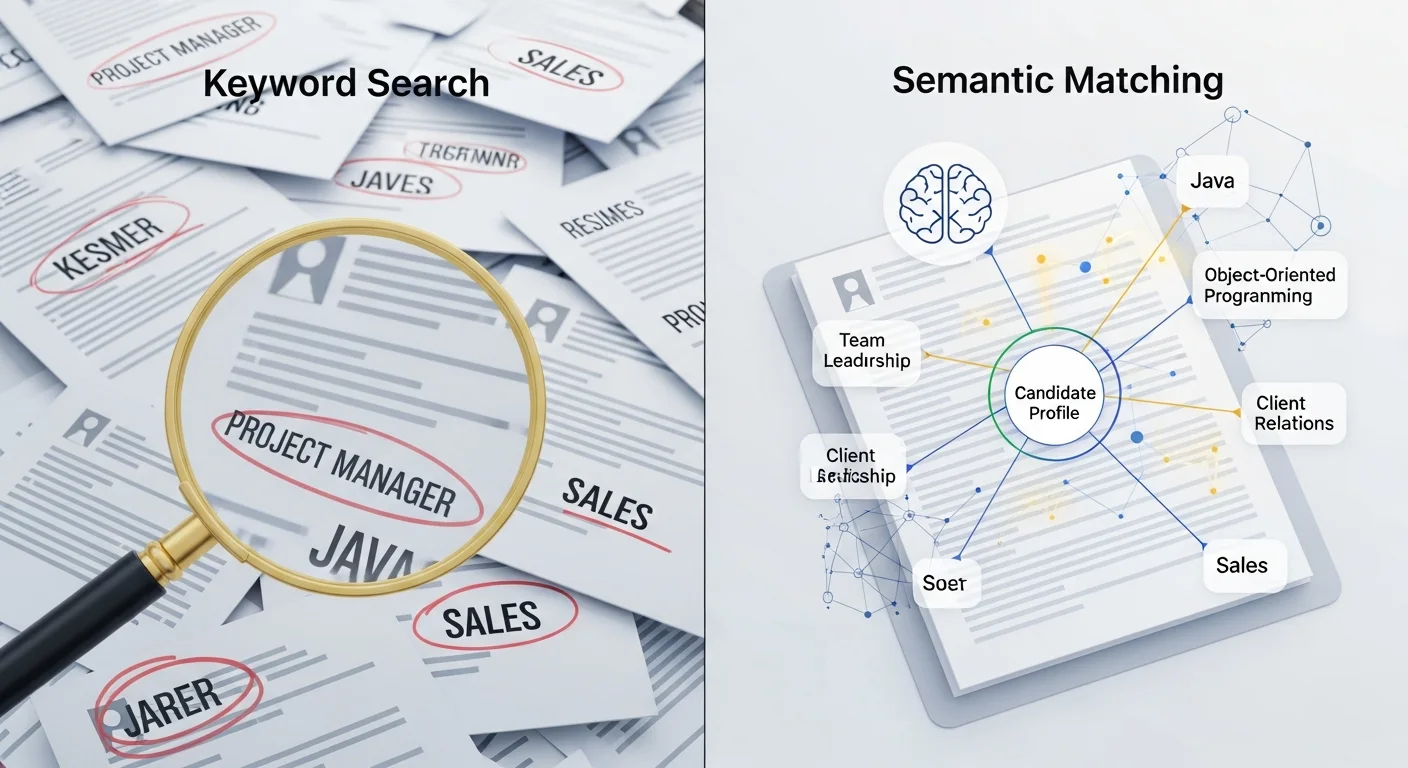
AI-assisted resume screening evaluates patterns in experience, skills, and progression instead of relying only on keywords.
For example, instead of filtering strictly for a specific job title, AI can surface candidates whose experience aligns with the intent of the role, even when titles differ. This is especially valuable as career paths become less standardized.
Many teams begin this transition by adopting semantic matching in recruitment to improve candidate relevance. Organizations using AI-assisted screening often report a meaningful reduction in false negatives, surfacing candidates who would have been filtered out by rule-based ATS logic.
Human-in-the-Loop Decision Models
Modern AI hiring tools follow a human-in-the-loop approach.
AI surfaces insights. Humans decide.
Recruiters can:
- Review why a candidate was surfaced
- Override recommendations
- Add context that the system can learn from
This model reflects how high-stakes decisions work in other domains: automation supports humans, but accountability stays human. Over time, this creates trust instead of resistance.
Transparency and Control in AI Hiring
Recruiters are far more likely to adopt AI when they understand it. Explainable insights, why a candidate fits, not just a score, are critical.
Black-box systems erode confidence. Transparent systems build it.
In effective AI hiring setups, control remains with the recruiter. AI becomes a decision partner, not a gatekeeper.
AI Hiring Implementation Guide
Transitioning to AI hiring doesn’t mean flipping a switch. It means evolving deliberately.
Audit Current Hiring Bottlenecks
Start by identifying where quality and time are being lost today:
- Resume screening overload
- Large, low-confidence shortlists
- Frequent manual overrides of ATS filters
These pain points consistently show up in hiring operations and are ideal starting points for AI support.
Introduce AI-Assisted Screening
Begin with AI supporting screening, not making final decisions.
Let recruiters compare AI insights with their own judgment. This parallel approach builds familiarity and confidence while keeping risk low. This phased approach reinforces who owns AI hiring decisions while building trust gradually.
Most teams that succeed with AI hiring start small, then expand once trust is established.
Define Override Rules and Accountability
Make it clear when and why recruiters should override AI recommendations. Overrides are not failures; they are part of human oversight in AI recruitment and a key source of system learning.
When overrides are documented and reviewed, AI systems improve over time, and recruiters' trust increases instead of declining.
Align Hiring Managers Early
Hiring managers must understand that AI improves shortlists, not replaces judgment.
Early alignment prevents unrealistic expectations and ensures hiring managers engage with AI insights constructively instead of skeptically.
Metrics to Track After Transition
Success in AI hiring is not just about speed. It’s about decision quality.
Quality-of-Hire
Track post-hire performance, retention, and ramp-up time. Better screening should translate into stronger long-term outcomes, not just faster fills.
Decision Confidence
Ask recruiters and hiring managers how confident they feel in shortlists and final decisions. Confidence is a leading indicator of system trust and adoption.
Reduction in False Negatives
Monitor how often strong candidates are surfaced through AI that would have been missed previously. This is one of the clearest, most practical benefits of AI hiring.
AI Hiring Best Practices for Long-Term Success
AI hiring works best when treated as a system, not a one-time feature.
Measuring Decision Quality
Move beyond time-to-fill. Track:
- Hiring outcomes
- Interview-to-offer ratios
- Post-hire performance signals
These metrics reflect whether AI is actually improving decisions.
Building Recruiter Trust in AI Outputs
Trust grows through transparency. Recruiters must understand why AI surfaces candidates. Opaque scores undermine confidence and adoption.
Ensuring Transparency and Fairness
AI should reduce bias, not hide it. Regular reviews, explainable logic, and human oversight are essential for fair hiring practices.
Continuous Improvement Loops
AI systems should learn from outcomes and recruiter overrides. This creates a feedback loop where hiring improves over time, not just gets faster.
How AICRUIT Supports Responsible AI Hiring
This is where intelligence layers begin to matter in practice.
AICRUIT doesn’t replace your ATS. It sits above it as an intelligence layer. Your ATS continues to handle workflows and compliance. AICRUIT focuses on interpretation and decision support.
By combining AI-assisted resume screening, interview intelligence, and contextual insights, AICRUIT helps recruiters:
- Reduce screening noise
- Surface relevant candidates faster
- Understand why candidates fit
Recruiters don’t lose control. They gain clarity.
Conclusion: Transitioning to AI Hiring Strengthens Recruiter Impact
The transition from ATS to AI hiring isn’t about technology; it’s about elevating the recruiter’s role. ATS platforms helped organize hiring. AI helps improve decisions.
When recruiters move from manual screening to decision stewardship, hiring becomes faster, fairer, and more human, not less.
The future belongs to teams that combine intelligence with judgment. AICRUIT exists to make that transition practical, transparent, and recruiter-first.
FAQs:
Q: What does transitioning from ATS to AI hiring mean?
It means adding an AI intelligence layer on top of an existing ATS to improve how candidates are evaluated and decisions are made, not replacing the ATS itself.
Q: Why is an ATS no longer enough for modern hiring?
ATS platforms track applicants but struggle to interpret non-linear careers, transferable skills, and context, leading to missed qualified candidates.
Q: How do recruiters use AI tools in hiring today?
Recruiters use AI to surface relevant candidates, reduce resume noise, and gain explainable insights, while retaining full control over final decisions.
Q: Does AI hiring replace recruiter judgment?
No. AI supports recruiter judgment by improving consistency and signal quality, but humans remain responsible for hiring decisions.
Q: What is the first step in an AI hiring implementation guide?
The first step is auditing, where hiring decisions slow down or break down, especially during resume screening and shortlisting.
Q: How do companies measure success after adopting AI hiring?
Success is measured through quality-of-hire, decision confidence, and reduced false negatives, not just faster time-to-fill.
Q: Is AI hiring fairer than traditional resume screening?
AI can reduce bias caused by rigid rules and fatigue, but fairness depends on transparency, human oversight, and continuous review.
Q: What are AI hiring best practices for long-term success?
Best practices include focusing on decision quality, using explainable AI, keeping humans in the loop, and learning from hiring outcomes.
Q: Can AI hiring work with existing ATS platforms?
Yes. AI hiring tools are designed to integrate with ATS platforms, enhancing decision-making without disrupting workflows.
Q: How does AICRUIT help with the transition from ATS to AI hiring?
AICRUIT adds an intelligence layer that improves resume screening and hiring decisions while allowing teams to keep their existing ATS.




.webp)