Hiring teams rarely ignore good candidates on purpose. Yet it happens every day. A resume that clearly shows experience, growth, and capability never makes it past the first screen. A strong engineer never gets shortlisted. A high-potential product manager never reaches an interview. A career switcher with exactly the right skills disappears into the void.
When recruiters later review the pipeline, the question is always the same: How did we miss them?
On the other hand, a polished, keyword-heavy, and perfectly formatted resume moves forward despite weaker real-world alignment.
This disconnect isn’t random. It’s the predictable outcome of how most recruitment systems still work.
At the center of this problem is the difference between keyword-based resume screening and semantic matching in recruitment, which determines whether hiring systems reward surface visibility or real candidate relevance
Within the first moments of modern hiring, decisions are often shaped by semantic matching in recruitment, or more accurately, the lack of it. Traditional systems still rely on keyword logic to determine relevance, even though human potential doesn’t operate on exact word matches.
The result is a hiring process that rewards visibility over value, optimization over authenticity, and familiarity over fit.
Why the “Best Resume” Often Gets Ignored
Modern hiring doesn’t fail because recruiters can’t spot talent. It fails because systems decide who gets seen prior to the recruiter's engagement. Before we look at technology, it is important to analyze behavior from both candidates and hiring systems.
The Illusion of Relevance in Keyword-Heavy Resumes
Keyword-heavy resumes create a powerful illusion. On the surface, they look aligned. They mirror job descriptions, repeat role-specific terms, and appear perfectly aligned. But alignment on paper doesn’t always reflect real capability.
Keyword matching rewards similarity, not substance. A resume that looks relevant rises to the top, even if the experience behind it is shallow or misaligned.
Two candidates may list the same skills, but only one may have applied them meaningfully in real scenarios. Keyword-based systems struggle to see that difference because they equate frequency with competence.
How Candidates Adapt to ATS Logic
Candidates are not unaware of this reality. Once they understand how systems work, they optimize for them. Resumes become engineered documents rather than honest representations of experience. They are now written for machines first and humans second. Candidates copy-paste job descriptions, inflate skill sections, and optimize wording purely to pass filters. Skills are added because they’re searchable, not because they’re true. This adaptation isn’t dishonest; it’s defensive.
When systems reward surface-level matching, candidates respond accordingly. And recruiters spend more time validating resumes than evaluating people.
The Visibility vs Quality Problem
Here’s the core issue: visibility is not quality. This creates a fundamental imbalance. Visibility becomes the gatekeeper, not capability. Keyword-based systems surface candidates who match language, not those who match intent. So the candidates who know how to “speak ATS” rise to the top, and the most capable candidates often remain invisible, especially those with non-linear careers or transferable skills. This is one of the core reasons why ATS misses qualified candidates, even when teams believe their process is fair.
How Keyword-Based Hiring Systems Work
To understand why modern hiring systems struggle to identify the right candidates, we first need to understand how keyword-based hiring actually functions behind the scenes. Most of the failure doesn’t come from bad intent or poor configuration; it comes from structural design choices made years ago, when hiring looked very different.
Resume Parsing and Keyword Indexing
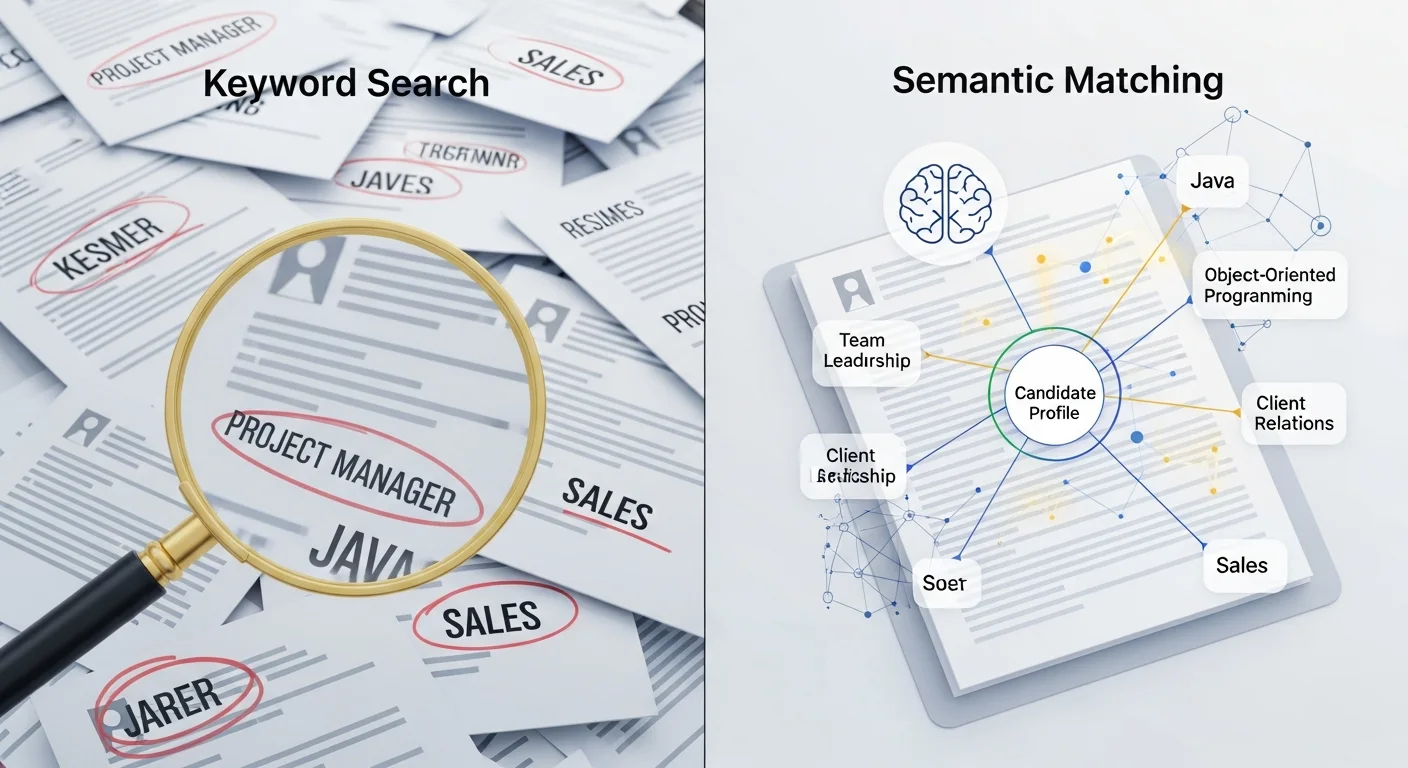
At the heart of most Applicant Tracking Systems is a resume parser. When a candidate uploads a resume, the system doesn’t “read” it the way a human does. Instead, it breaks the document into structured data fields.
Job titles are placed into a title field. Company names become employment history entries. Skills are pulled into a skills section. Once this information is extracted, the ATS indexes it much like a search engine indexes web pages. From that point on, the resume is no longer treated as a narrative of experience. It becomes a searchable database record.
When a recruiter searches or applies filters, the system matches resumes based on literal terms, words, phrases, and predefined tags. If the resume contains the same or similar terms as the query, it surfaces. If it doesn’t, it disappears from view.
Importantly, the system is doing exactly what it was designed to do. It’s fast, consistent, and predictable. The problem isn’t a malfunction. The problem is interpretation, or rather, the lack of it.
What Keyword Search Does Well
It’s easy to criticize keyword-based screening, but it’s important to acknowledge why it became the dominant model in hiring technology.
Keyword search excels at handling scale. It can process thousands of resumes instantly and apply consistent logic without fatigue. For roles with strict, non-negotiable requirements, such as certifications, licenses, or highly standardized skills, it provides a quick way to reduce volume.
This efficiency is precisely why keyword logic powered early ATS platforms. At a time when hiring was overwhelmed by application volume, keyword-based filtering solved an urgent operational problem. It helped recruiters survive the inbox explosion.
In that context, it worked.
Where Keyword Logic Breaks Down at Scale
The problem comes up when hiring gets more complicated, which is pretty much the case most of the time these days. Keyword systems don’t understand meaning. They don’t recognize that “customer success” and “account management” may involve overlapping skills. They can’t infer that someone who built internal tools may be well-suited for a product role, even if the title doesn’t match exactly. They can’t recognize synonyms, infer related skills, or understand how experience transfers across domains.
At scale, this creates a dangerous illusion. The hiring process feels efficient because resumes are being filtered quickly. But the results are shallow. The shortlist reflects who matched the system, not who matched the role.
This is why so many teams feel like they’re hiring fast, but not hiring well.
How Semantic Matching in Recruitment Works
Semantic matching in recruitment evaluates candidates based on meaning, context, and intent rather than exact keyword matches, allowing hiring systems to understand how skills, experience, and roles relate to one another.
Instead of asking whether a resume contains specific words, it asks a more practical question: Does this experience actually make sense for the role?
This shift matters because human careers don’t follow rigid templates. Skills show up in different roles, titles vary across companies, and experience often transfers in ways that keywords alone can’t capture.
Understanding Meaning, Not Keywords
Semantic systems focus on what a candidate has done, not just how they describe it. They look at how skills are applied in real situations, how responsibilities evolve, and how different roles connect conceptually.
Rather than matching exact phrasing, semantic matching interprets intent. It understands that similar outcomes can be achieved through different paths, even when resumes use different language.
Mapping Transferable Skills
One of the biggest advantages of semantic matching is its ability to recognize transferable skills. Candidates moving between functions or industries are no longer filtered out simply because their job titles don’t line up perfectly.
Traditional systems treat titles as fixed labels. Semantic systems treat them as signals, evaluating the underlying work instead of the label attached to it.
Context-Aware Candidate Matching
Context adds nuance to evaluation. The same skill can signal different strengths depending on where and how it was applied. Semantic matching considers factors like company environment, role scope, and progression, allowing hiring systems to surface relevant candidates, not just visible ones.
This is what allows recruitment systems to move from basic matching toward real understanding.
Semantic Search vs Keyword Search in Hiring
This distinction sits at the core of modern hiring intelligence. The way a system searches determines not just who gets surfaced, but how hiring decisions are shaped. The difference here is not speed versus accuracy, but surface matching versus contextual understanding, which fundamentally changes who gets seen and who gets missed.
Candidate Relevance vs Resume Visibility
Keyword search is designed to surface what is most visible. It prioritizes resumes that closely mirror job descriptions, use familiar terminology, and repeat expected phrases. Semantic search, on the other hand, prioritizes relevance. It evaluates whether a candidate’s experience aligns with the intent of the role, even if the language differs.
This difference matters because relevance is a far better predictor of on-the-job performance than familiarity. Keyword search optimizes the hiring process. Semantic search optimizes hiring outcomes.
False Negatives and Talent Loss
At scale, keyword-based systems create false negatives. Genuinely qualified candidates are filtered out simply because they don’t use the “right” words. Their experience aligns, but their language doesn’t.
Over time, this silent filtering leads to measurable damage. Roles take longer to fill, pipelines feel thinner, and teams struggle to explain why strong candidates seem so hard to find. The talent isn’t missing, it’s being filtered away.
Recruiter Trust in Screening Outputs
When recruiters consistently feel the need to override system recommendations, trust breaks down. Shortlists stop feeling credible, and automation turns into something that needs constant supervision.
Recruiters begin re-screening resumes manually, not because they want to, but because they have to. This undermines the purpose of automation and contributes directly to fatigue and burnout.
Why Semantic Matching Enables Hiring Intelligence
This is why semantic matching is foundational to a hiring intelligence layer, it allows systems to interpret signals instead of enforcing static rules.
Better Perception Improves Hiring Decisions
Hiring intelligence depends on perception. If a system can’t accurately perceive relevance, context, and potential, it can’t support good decisions, no matter how advanced the automation looks on the surface.
Hiring decisions improve when systems surface candidates based on contextual fit rather than surface similarity. When relevance is determined by how experience aligns with role intent, recruiters spend less time correcting the system and more time exercising judgment.
This is where intelligence enters the hiring process. The system doesn’t decide for the recruiter; it sharpens what the recruiter sees.
Reduced Resume Screening Bias
By evaluating meaning instead of formatting or keyword density, semantic matching reduces bias introduced by resume optimization tactics. Candidates are assessed more equitably based on experience and potential.
Foundation for Intelligence-Led Hiring Systems
Semantic matching is a prerequisite for intelligence-led hiring systems. Without understanding meaning and context, systems can’t learn from outcomes, adapt to new role requirements, or provide reliable decision support.
This is where platforms like AICRUIT step in.
How AICRUIT Applies Semantic Matching in Real Hiring Workflows
AICRUIT doesn’t treat semantic matching as a feature; it treats it as infrastructure.
By combining AI-powered screening, interview intelligence, and contextual evaluation, AICRUIT enables hiring teams to move beyond keyword-based resume screening and toward signal-based decision-making. Candidates are assessed based on how their experience aligns with real role needs, not how closely their resumes resemble job descriptions.
Instead of asking recruiters to trust opaque filters, AICRUIT surfaces explainable insights that reflect actual candidate fit. Teams can keep their existing ATS while meaningfully upgrading how hiring decisions are made.
Conclusion: Recruitment Systems Must Evolve From Matching to Understanding
Hiring is not a search problem. It’s a decision problem.
Keyword matching helped organizations survive volume. Semantic matching helps them hire better. As roles become more complex and talent more diverse, systems that rely on surface similarity will continue to fall behind.
Semantic matching changes how hiring systems see candidates, but it’s only one part of a broader shift toward intelligence-led hiring. For recruiters, this shift becomes practical during AI-assisted screening and shortlisting, not abstract theory.
The future of recruitment belongs to systems that understand people, not just resumes. AICRUIT exists to make that transition practical, scalable, and human-centered.
FAQs
Q: What is semantic matching in recruitment?
Semantic matching in recruitment evaluates candidates based on meaning, context, and transferable skills rather than exact keyword matches.
Q: Why does keyword-based resume screening fail?
Keyword-based resume screening fails because it prioritizes wording over relevance, leading to false negatives and missed qualified candidates.
Q: How is semantic search different from keyword search in hiring?
Semantic search interprets intent and context, while keyword search relies on literal word matching and predefined filters.
Q: Can semantic matching work with an ATS?
Yes. Semantic matching layers work alongside ATS platforms to improve decision quality without replacing existing systems.
Q: How does AICRUIT use semantic matching?
AICRUIT applies semantic matching through AI-powered screening and interview intelligence to surface context-aware candidate insights.
Q: Why does ATS miss qualified candidates even with good configurations?
ATS platforms miss qualified candidates because they rely on keyword-based logic that evaluates similarity rather than contextual relevance, causing false negatives when experience doesn’t match predefined terms.





.webp)