Recruiter productivity metrics are the earliest and most reliable indicators of whether a hiring process is actually improving. Long before cost savings appear on dashboards or quality-of-hire data stabilizes, productivity metrics reveal how efficiently recruiter time converts into real hiring progress. Yet most organizations still measure recruiter performance using surface-level activity counts, resumes reviewed, requisitions opened, or time logged, without understanding whether those efforts produce better decisions.
As hiring volumes increase and roles become more complex, this gap becomes expensive. Recruiters feel busier, teams feel stretched, and leadership assumes productivity is rising when, in reality, effort is simply being redistributed. This is why modern talent teams are shifting their focus to recruiter productivity metrics that capture decision flow, screening efficiency, and outcome stability, especially before and after AI adoption. When measured correctly, these metrics show not just how fast recruiters work, but how effectively the hiring system itself operates.
Recruiter productivity metrics measure how effectively recruiter time and effort convert into qualified hiring decisions. Before and after AI adoption, these metrics reveal whether productivity gains are real, sustainable, and tied to decision quality rather than increased activity.
Why Recruiter Productivity Is the First ROI Signal
Hiring leaders often expect ROI to appear as a final number: lower cost per hire, faster time to fill, or better retention. Those outcomes matter, but they are delayed indicators. Productivity, by contrast, is immediate.
Hiring leaders and talent operations teams notice that when the initial evaluation process improves, recruiters gain more time and focus before any downstream metrics change. This improvement in productivity serves as a strong early indication of the recruiting process. It shows whether recruitment is becoming easier, more stable, and more repeatable. If productivity does not improve, it is unlikely that long-term return on investment (ROI) will follow.
What Recruiter Productivity Actually Means
Recruiter productivity is often misunderstood as speed alone. In reality, it is about how recruiter time is distributed and whether that time produces forward movement.
True productivity in talent acquisition is defined by three specific levers:
- Req Capacity: How many open roles can one recruiter manage without the quality of hire dropping?
- Time Allocation: What percentage of the day is spent on high-value tasks (interviewing, selling) vs. low-value tasks (scheduling, screening)?
- Funnel Velocity: How fast does a qualified candidate move from "Applied" to "Interview"?
Productivity reflects balance. Recruiters spend less time filtering noise and more time engaging candidates, aligning with hiring managers, and moving decisions forward. The measure is not activity, but useful progress.
Recruiter Productivity Before AI Adoption
In the traditional manual workflow, productivity has a hard ceiling. It is a biological limit. A human recruiter, no matter how talented, eventually hits a wall of cognitive load.
Time Spent per Resume
Before AI adoption, a large portion of recruiter time was consumed by reviewing resumes one at a time. Each resume requires careful reading, comparison against role requirements, and judgment calls about potential fit. As application volume grows, this time adds up quickly. Hours that could be spent speaking with candidates or aligning with hiring managers are instead absorbed by repetitive screening work, limiting overall productivity.
Decision Fatigue and Inconsistency
As recruiters move through dozens or hundreds of resumes, decision fatigue naturally sets in. Maintaining the same level of focus throughout long screening sessions becomes difficult. Early resumes may be reviewed carefully, while later ones are assessed more quickly or with slightly different standards. Over time, it leads to uncertainty, second-guessing, and the need to revisit earlier decisions, which further slows down the process.
Throughput Ceilings in Manual Screening
Manual screening also creates a hard limit on how much work a recruiter can complete in a day. There is a maximum number of resumes that can be reviewed thoughtfully before speed starts to replace careful evaluation. Once this limit is reached, productivity stops increasing, even if recruiters work longer hours. Teams may try to push through higher volumes, but doing so often results in rushed decisions or missed candidates. This throughput ceiling makes it difficult to scale hiring without sacrificing consistency or quality.
Recruiter Productivity After AI Adoption
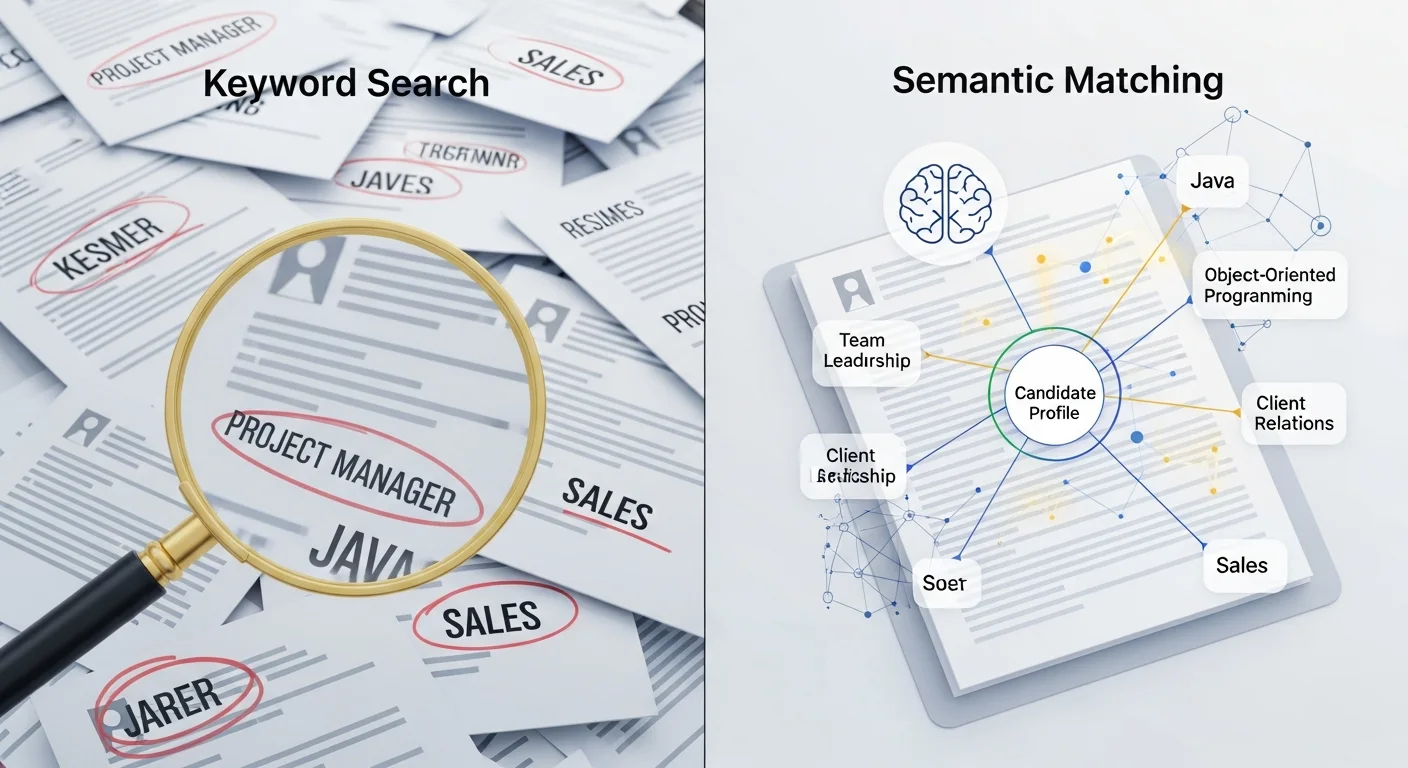
When you introduce AI, you don't just improve the metrics; you change the physics of the process. After AI adoption, AI recruiter productivity improves in measurable ways, driven by faster screening cycles and more consistent decision flow.
Candidates Evaluated per Hour
After AI adoption, recruiter productivity improves in how many candidates can be evaluated within the same amount of time. Recruiters are no longer forced to start from scratch with every resume. Instead of spending most of their time filtering obvious mismatches, they can focus attention on candidates who are more likely to be relevant. As a result, the number of candidates reviewed per hour increases without increasing mental load.
Stability of Shortlist Quality Under Volume
One of the clearest signs of improved productivity is stability. When application volume increases, productivity often drops in manual processes. After AI adoption, shortlist quality remains more consistent even as volume grows. Recruiters see fewer swings in decision quality between low-volume and high-volume periods. This stability reduces stress and makes workload planning more predictable, because recruiters can trust that early decisions will hold up regardless of how many applications arrive. Consistent shortlists mean fewer surprises later in the process.
Reduced Re-Screening and Backtracking
Another important productivity gain appears in how often recruiters need to revisit earlier decisions. Before AI, recruiters frequently returned to rejected resumes or rebuilt shortlists when initial decisions proved unreliable. After AI adoption, early evaluations are more consistent, which reduces the need for re-screening. Recruiters spend less time second-guessing past choices and more time moving forward. This reduction in backtracking saves time quietly but significantly, freeing up capacity for higher-value work like candidate engagement and stakeholder communication.
Key Takeaway:
Measuring the Shift: When measuring recruiter productivity before and after AI, the focus shifts from "activity" to "outcomes".
-
Before AI: Success is measured by Time Spent (e.g., hours screening, resumes read). Throughput is capped by human endurance.
-
After AI: Success is measured by Velocity (e.g., candidates advanced, shortlist accuracy). Throughput becomes elastic and scalable.
The Core Delta: AI removes the linear relationship between application volume and recruiter workload.
This early productivity shift directly supports broader ROI measurement, as outlined in AI recruiting ROI.
Recruiter Productivity Metrics That Matter Most
The most meaningful productivity metrics focus on time and decision flow, not surface activity. Below are the recruiter efficiency metrics that actually show progress:
1. Screening time per recruiter
This metric tracks how many hours a recruiter spends reviewing candidates at the earliest stage of the hiring process.
Measure the total hours a recruiter spends in the "New Applicant" stage.
- Before: 10+ hours per week per role.
- After: <1 hour per week per role (focused only on the shortlist).
- The Win: This time is now reinvested into candidate relationship management.
2. Candidates reviewed vs. advanced
This ratio reveals how efficiently a recruiter effort turns into forward movement.
- Before: 100 reviewed / 10 advanced (90% wasted effort).
- After: 15 reviewed (from the AI shortlist) / 10 advanced (High-yield effort).
- The Win: Recruiters stop being data processors and start being talent advisors.
3. Shift toward higher-value recruiter work
The most telling productivity signal is how recruiter time shifts toward higher-value activities. This can be measured by the share of the workweek spent on phone screens, interviews, and direct candidate conversations.
Track the percentage of your team's week spent on phone screens and interviews.
- Before: 30% of the week.
- After: 70% of the week.
- The Win: Higher engagement with top talent directly correlates to higher acceptance rates.
Where Productivity Gains Stabilize
Productivity improvements do not increase forever, and that is not a sign of failure. As early-stage screening becomes more efficient, recruiters eventually reach a point where additional gains slow down and stabilize. At this stage, screening is no longer the main constraint on productivity, and further improvements depend on factors outside early evaluation.
Stabilization occurs because recruiting still requires human judgment, coordination, and conversation. Once recruiters are spending less time filtering candidates and more time engaging them, productivity shifts from speed to quality. The work becomes more balanced, but not infinitely faster.
When productivity stabilizes, it also becomes more predictable. Recruiters can plan their workload with greater confidence, teams can scale hiring without burnout, and leadership gains a clearer view of capacity. Teams often uncover fewer candidate rejection errors, reducing rework and repeated screening effort. At this point, productivity metrics stop showing rapid gains but start showing consistency, and consistency is what enables long-term hiring performance.
When Recruiter Productivity Does Not Improve
Recruiter productivity does not improve simply by adding AI to an existing workflow. Gains stall when job requirements are poorly defined, screening criteria are inconsistent, or recruiters are forced to override AI outputs due to a lack of trust or transparency. In these cases, AI accelerates noise rather than reducing it.
Productivity improves only when AI is paired with clear role definitions, structured evaluation logic, and disciplined workflow design. Without these foundations, organizations mistake automation for efficiency and see little real impact on recruiter output.
Using Productivity as an Early ROI Signal
Productivity is one of the earliest indicators that recruiting ROI is beginning to materialize. Unlike cost or final hiring outcomes, which take time to appear, productivity changes are visible almost immediately. When recruiters can move candidates forward with less effort and less rework, it signals that early-stage decisions are becoming more effective.
When screening effort decreases while the number of qualified candidates advancing remains stable, it shows that hiring work is becoming more efficient. This shift often appears weeks or months before improvements in cost or time-to-hire are reflected in reports.
Productivity also acts as a leading indicator. When recruiter workload becomes more predictable and less fragmented, downstream outcomes tend to improve naturally. Fewer delays, stronger candidate engagement, and more consistent shortlists are all built on this foundation.
For leadership, productivity provides a practical way to evaluate ROI without waiting for long hiring cycles to finish. It shows whether the recruiting system is becoming easier to operate and more sustainable over time. When productivity improves early and remains stable, it creates the conditions for measurable gains across the rest of the hiring process.
Conclusion
Recruiter productivity improvement is often the first clear sign that hiring ROI is beginning to take shape. Long before cost savings appear in reports or hiring outcomes are finalized, productivity changes become visible in daily work. Recruiters move through tasks with less friction, decisions feel more consistent, and progress through the hiring funnel becomes steadier. These early signals matter because they show whether recruiting effort is being converted into real momentum.
When productivity increases without sacrificing decision quality, it indicates that early-stage hiring effort is being used more effectively. Recruiters spend less time sorting through noise, revisiting earlier decisions, or compensating for weak shortlists. Instead, they focus more on advancing qualified candidates and engaging meaningfully with talent.
Over time, these gains compound across the organization, improving overall hiring team productivity by reducing bottlenecks between recruiting, hiring managers, and interview panels and creating a strong foundation for every other ROI metric. Faster hiring, lower costs, and better outcomes do not emerge in isolation; they are built on consistent, efficient early-stage work. Without productivity improvement, downstream gains are difficult to sustain.
In recruiting, measurable progress does not begin with tools, features, or final results. It begins with how effectively recruiter time is used. Productivity is the starting point, and when it improves and stabilizes, it signals that hiring ROI is no longer theoretical; it is actively taking shape.

.webp)