A recruiter closes another role, the dashboard updates, and the process moves on. On paper, everything looks fine. Yet somewhere in the process, a qualified candidate was quietly filtered out and never heard from again. This is the unseen cost of false negatives in hiring, and for most organizations, it is one of the most expensive problems they never measure.
Hiring teams spend significant time tracking who they hire and how long it takes. What they rarely examine is who they rejected early and what that decision ultimately cost the business. Those invisible decisions accumulate silently, shaping vacancies, productivity gaps, and long-term hiring outcomes in ways that never appear in standard reports. These are the ghosts of your hiring funnel, and while their absence doesn't show up on a spreadsheet, they are silently bleeding your organization dry.
Over time, false negatives create delays, repeat searches, and lost opportunities that compound across teams and quarters.
What is a false negative in hiring?
False negatives in hiring occur when qualified candidates are rejected during early screening, preventing them from ever being evaluated in interviews or later stages. These decisions rarely appear as errors, yet they create extended vacancies, repeated searches, and hidden business costs that accumulate over time.
Standard hiring metrics rarely capture this problem. Time-to-hire measures speed. Cost-per-hire measures the spend. Offer acceptance rates measure closing success. None of these metrics reveals how many capable candidates were removed before they ever had a chance to demonstrate fit.
Recruiters prioritize speed over accuracy. They treat the screening process like a security checkpoint where the goal is to stop threats (bad hires), rather than a gold mine where the goal is to extract value. They view rejection as a safety measure, but inherently accept high rates of hiring false negatives as the cost of doing business. In a job market where talent is hard to find, this approach is not sustainable. By turning down potential candidates, you are not just saving time; you are also losing possible revenue.
False negatives are considered an acceptable loss. The assumption is that strong candidates will reemerge. In practice, many do not; they move on, accept other roles, or completely disengage from the employer. The system rewards completion, not missed opportunities.
The Invisible Cost of Candidates You Never Meet
Most hiring teams believe their highest costs come from open roles or bad hires. In reality, a large portion of hiring costs comes from decisions that feel harmless at the moment they are made. When a capable candidate is rejected early, there is no immediate alarm. The process simply continues.
False negatives are rarely measured because they leave no obvious trail. Unlike a bad hire, which creates visible problems, a rejected candidate disappears quietly. The cost only appears later, when roles stay open longer, teams operate understaffed, or the same position is reopened months later.
Industry hiring leaders and workforce analysts have repeatedly noted that early-stage decisions have an outsized impact on outcomes, yet most organizations evaluate ROI only at the end of the funnel. This mismatch makes false negatives one of the most persistent blind spots in recruiting.
Why False Negatives Occur in Early Screening
To solve the problem, we have to understand the mechanics of the mistake. We won't get into the technical weeds here, but we must acknowledge the three horsemen of rejection errors: time pressure, proxy-based evaluation, and inconsistent thresholds.
- Time Pressure
False negatives tend to cluster at the earliest stages of hiring, where volume is highest and time is limited. Recruiters are often forced to make quick decisions under pressure, especially during high-volume periods. The faster the process moves, the higher the chance that capable candidates are overlooked. - Proxy-based evaluation
When time is limited, recruiters rely on familiar signals such as company names, job titles, or linear career paths. These shortcuts feel efficient, but they increase the likelihood of rejecting candidates whose experience does not follow expected patterns. This is a common source of hiring false negatives, particularly for candidates with transferable skills or non-traditional backgrounds. - Inconsistent thresholds
Evaluation standards can shift based on workload, urgency, or reviewer fatigue. A candidate rejected on one day might have advanced on another. This inconsistency increases candidate rejection errors, even when recruiters are experienced and well-intentioned.
The Financial Impact of False Negatives
Let's move from the theoretical to the financial. The reason most CFOs don't panic about false negatives is that they are harder to quantify than a severance package. But make no mistake, the cost of bad screening decisions is astronomical when you look at the ripple effects.
The financial cost of false negatives is indirect but substantial. One of the most immediate effects is extended vacancies. When qualified candidates are rejected early, roles remain open longer than necessary. Each additional week of vacancy represents lost output, delayed projects, and increased pressure on existing staff.
Re-hiring and delay costs compound this problem. Teams often relaunch searches, engage external agencies, or invest additional recruiter hours to find candidates who were already available earlier in the process. This cost is rarely labeled as such, but it appears in inflated hiring spend and repeated effort.
Lost productivity is another major factor. When roles remain unfilled, work does not disappear. It is redistributed across teams, leading to burnout, reduced quality, slower execution, and recruiter effort increases downstream, affecting recruiter productivity metrics. Over time, these productivity losses exceed the visible costs of recruiting itself. When qualified candidates are rejected early,
Harvard Business Review and SHRM have both highlighted that vacancy costs often outweigh hiring costs, yet most organizations focus their measurement on speed rather than on missed opportunity. False negatives are a primary driver of that imbalance.
False Negatives and DEI Outcomes
The damage isn't just financial; it is structural. False negatives have a measurable impact on diversity outcomes, even when diversity is not explicitly considered during screening.
Think about what a "safe" resume looks like. It follows a linear path. It uses standard industry terminology. It often signals a specific socioeconomic background. Now consider candidates from underrepresented groups. They might have non-linear career paths. They might have transferable skills gained in different industries. They might be returning to the workforce after caregiving. These are often the candidates with the grit, adaptability, and fresh perspectives that drive innovation. Similarly, candidates with career breaks or cross-industry experience are also more likely to be filtered out early.
Because these candidates are rejected before interviews, the impact is indirect. Diversity metrics later in the funnel may look balanced, while early attrition goes unnoticed. Over time, this pattern reduces representation at the top of the funnel without triggering obvious warnings.
This is why DEI outcomes cannot be evaluated only at the hiring or offer stages. False negatives at screening quietly shape who ever gets considered.
How Structured Screening Reduces False Negatives
False negatives are not eliminated through effort alone. They are reduced through consistency. When early evaluation follows stable criteria and comparable thresholds, fewer capable candidates are rejected by chance.
Structured screening reduces false negatives by consistently advancing the right candidates based on role-relevant signals instead of proxies. When evaluation logic remains consistent across volume, the likelihood of missing qualified candidates decreases.
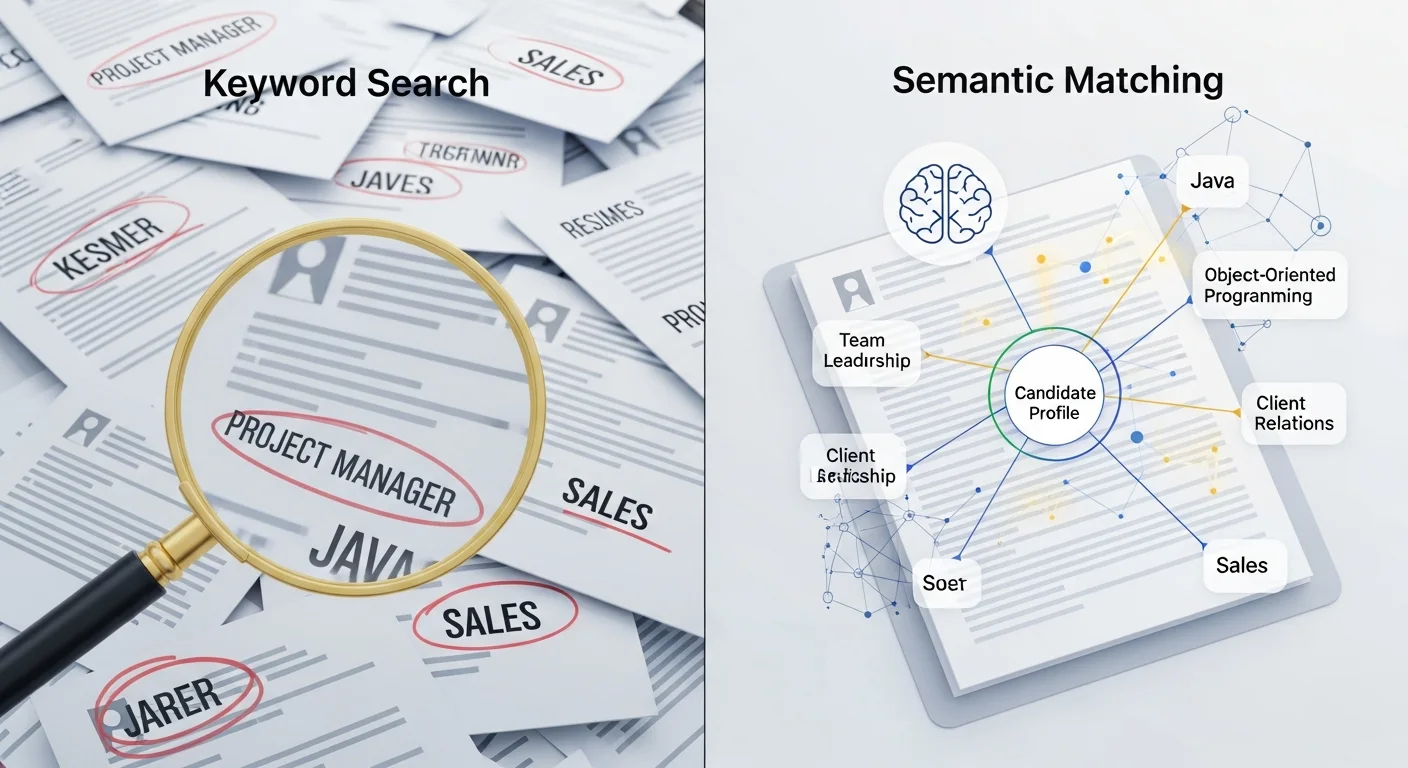
When you use advanced AI that focuses on semantic matching rather than keyword matching, you stop penalizing candidates for using the wrong synonyms. You start seeing the "Teacher" who has all the organizational skills of a "Project Manager." You start seeing the "Self-Taught Coder" who has more practical ability than the CS graduate. This is the consistency of evaluation. A structured system doesn't get tired after lunch. It doesn't get annoyed by a funky font. It evaluates the 1,000th candidate with the exact same rigor as the 1st.
At scale, structured evaluation also allows teams to assess candidates in context rather than isolation. This reduces the tendency to dismiss profiles that do not match narrow expectations but still align with role requirements.
Platforms like AICRUIT focus on enabling consistent, outcome-oriented screening decisions so teams reduce unnecessary rejection without slowing down hiring. The value lies not in speed alone, but in fewer missed opportunities.
How Teams Can Measure False Negatives
False negatives can be measured, but only if teams intentionally look for them. They often remain invisible unless ownership is clear, typically shared between recruiting leaders (process design) and hiring managers (decision thresholds).
Furthermore, the effective approach is shadow screening. This involves taking a random sample of resumes that were rejected at the screening stage, say, fifty profiles from last month. Have your most senior, most skilled recruiter or hiring manager review them deeply, spending five to ten minutes on each one. The goal is to look for people who could have done the job but were rejected for superficial reasons. By periodically reviewing a sample of rejected candidates after roles are filled, teams can identify patterns where capable candidates were removed early.
Rejected-candidate audits provide another lens. By examining whether previously rejected candidates succeed in similar roles elsewhere or reapply successfully later, teams gain insight into screening gaps. If you find that five out of those fifty rejected candidates were actually worth an interview, you have a 10% false negative rate. Multiply that across your entire applicant volume, and the numbers become terrifying. You can also track "Silver Medalists", candidates who were rejected for one role but hired for another role internally or by a competitor. If you see a trend of rejected candidates thriving elsewhere, that is your smoke signal. These audits often reveal that rejection decisions were driven by timing or inconsistency rather than lack of fit.
Another powerful approach is to implement a "Reconsideration Loop." This involves using your AI tool to periodically re-scan your database of past applicants against new open roles. Often, a candidate who was a "false negative" for a Senior Manager role might be a perfect "true positive" for a Mid-Level lead role. By constantly resurfacing "lost" talent, you convert waste back into value.
AI recruiting platforms like AICRUIT help teams reduce false negatives by bringing consistency to early evaluation and making decision patterns visible. The value is not in automating rejection, but in reducing unnecessary loss. When fewer qualified candidates are missed, roles fill faster, searches are not reopened as often, and recruiter effort is used more efficiently. Reducing false negatives strengthens early decision quality and supports long-term AI recruiting ROI.
By treating early rejections as data rather than dead ends, teams move from guessing to measuring. That shift is what turns false negatives from an invisible problem into a manageable cost driver.
Organizations that pair this analysis with insights from unbiased resume screening and AI-driven resume screening tools gain a clearer picture of how early decisions affect cost and performance.
Conclusion
Recruiting ROI does not end with the candidates you hire. It also includes the talent you never realized you lost. False negatives represent missed opportunities, extended vacancies, and hidden costs that quietly shape business performance.
When teams measure only speed and completion, these losses remain invisible. When they begin to examine early rejections, the full cost of hiring decisions comes into view.
In hiring, value is not defined solely by who joins the organization. It is also defined by those who were capable of joining but never got the chance.

.webp)