Transferable skills are abilities developed in one role that can be applied successfully to another, even when job titles or industries differ. Yet in modern hiring, these skills are frequently overlooked, not because candidates lack them, but because traditional screening methods remain anchored to titles and linear career paths rather than a skill-based hiring mindset.
Imagine a recruiter reviewing resumes late in the afternoon. One candidate has strong experience, but the titles don’t align perfectly with the role. The skills feel relevant, but the path looks unconventional. With dozens more resumes waiting, the safer choice is to move on. That decision isn’t careless. It’s human. And it’s exactly how transferable skills get buried.
This is where AI identifying transferable skills changes the equation. As careers become less linear and roles evolve faster than job descriptions, hiring success increasingly depends on the ability to recognize capability that doesn’t come wrapped in familiar labels.
Why Transferable Skills Are Often Overlooked
Hiring systems were built for predictability. Career ladders, clear titles, and sequential growth made screening straightforward. That model no longer reflects reality.
Most professionals today build experience across roles, functions, and even industries. Yet early-stage hiring still favors linear progression. Recruiters naturally gravitate toward what looks familiar, especially under time pressure. Job titles become shortcuts for decision-making. This "safe hire" mentality creates a massive blind spot. We convince ourselves that "industry experience" is a proxy for "competency," but they are not the same thing. By overlooking hidden skills in resumes, companies limit themselves to a shrinking pool of "perfect on paper" candidates, driving up salary costs and leaving incredible talent on the table.
The result is a quiet narrowing of the talent pool. Candidates with adjacent or cross-functional experience are filtered out before they ever reach an interview. Over time, this leads to slower hiring, reduced diversity, and missed potential, not because standards are high, but because visibility is low.
What Transferable Skills Really Mean
To solve this, we first need to redefine what we are looking for. There is a misconception that "transferable skills" are just soft skills like "good communication" or "hard worker." While those are part of it, the concept goes much deeper. They are concrete capabilities demonstrated through action, responsibility, and outcomes.
Transferable skills are the functional capabilities that travel with a professional regardless of their industry. They are the mechanisms by which work gets done. These include skills like stakeholder management, analytical reasoning, execution under ambiguity, system thinking, and leadership influence. They appear across roles but are described differently depending on context. For example, "Project Management" is not just a job title; it is a transferable skill set comprising budgeting, timeline management, risk assessment, and resource allocation. A wedding planner has these skills. A construction foreman has these skills. A software development lead has these skills. This highlights the necessity of recognizing the diverse cross-functional skill capability that exists beyond job titles. A resume might show them implicitly through projects, decisions, or scope rather than naming them directly.
This is why hidden skills in resumes often go unnoticed. Candidates summarize years of experience into a limited space, prioritizing roles and titles over the underlying work. Without deeper interpretation, much of their real value remains invisible during screening.
Why Transferable Skills Matter for Hiring Outcomes
The shelf life of a technical skill is now estimated to be 2.5 years. The coding language you hire for today might be obsolete by 2030. However, the ability to learn, to analyze data, and to lead teams, transferable skills, does not expire. Organizations that recognize transferable skills make better hiring decisions, even when roles are difficult to fill.
When evaluation focuses on capability rather than background similarity, quality of hire improves. Candidates adapt faster, collaborate better, and grow into roles rather than struggling to fit predefined molds. This approach also expands talent pools without lowering standards, because relevance is defined by skills, not history.
In competitive hiring environments, transferable skills reduce time-to-fill by surfacing candidates who would otherwise be overlooked. Instead of waiting for the “perfect” resume, teams identify strong potential earlier and move faster with confidence.
Why Traditional Screening Misses Them
If the value is so clear, why is the industry so bad at capturing it? The answer lies in the limitations of the tools we have used for the last twenty years.
Human bias and time pressure
Recruiters work under intense time constraints. To manage volume, they rely on heuristics, titles, keywords, recent roles, and recognizable companies. They look for prestige markers: a famous university, a competitor's company name, or a specific degree. This is "Pedigree Bias." It is nearly impossible for a human to consistently apply deep critical thinking to every single resume in a high-volume queue. They scan for what is familiar, and overlooked high-potential candidates are the collateral damage of this efficiency. These shortcuts are understandable, but they’re blunt instruments.
Keyword-based filtering
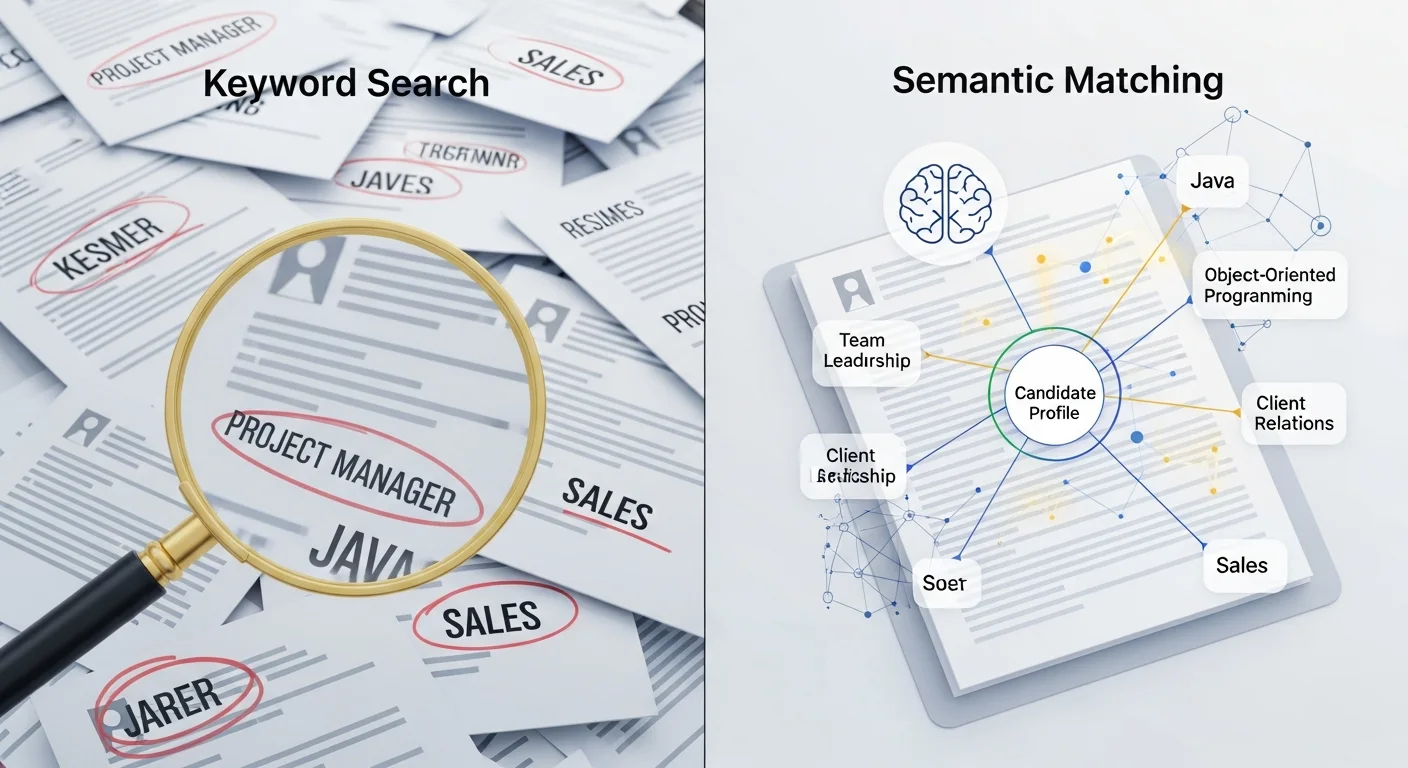
The legacy Applicant Tracking System (ATS) was designed as a filing cabinet, not a brain. It functions on Boolean logic. If you search for "Python," it looks for the string of characters P-Y-T-H-O-N. If a candidate writes "extensive experience in backend scripting for data science," a basic keyword filter might miss them entirely. Keyword-based systems prioritize exact matches and rigid criteria. Equivalent skills described differently are treated as irrelevant. This exact-match rigidity means that candidates who don't know the "secret password" of keywords are invisible, regardless of their actual ability.
Keyword filters struggle with cross-functional skill matching, especially when experience spans roles, teams, or industries.
ATS rigidity and resume structure limits
Furthermore, traditional screening struggles with the structure of resumes. It expects a chronological list of duties. It doesn't know how to weigh a "side project" where a candidate built an app, or a "volunteer role" where they managed a budget. If the data isn't in the standard "Work Experience" block, the ATS often ignores it. This structural rigidity prevents the system from seeing the holistic picture of a candidate's capability.
How AI Identifies Transferable Skills
AI approaches resume screening differently by changing what it looks for and how it interprets information.
Through AI-based skill inference, systems interpret experience contextually, enabling capability-based candidate evaluation rather than surface-level filtering. The system then examines what candidates actually did, not just what they called it. Responsibilities, scope, and patterns of work become signals. This is exactly how AI identifies transferable skills in resumes that appear unrelated at first glance.
Transferable skills analysis helps identify patterns across different jobs and industries by looking at large amounts of data. It shows how experience in one area can lead to success in another, even when the connection isn’t obvious. This process allows us to understand skills across various career paths.
Most importantly, AI aligns these inferred skills with job requirements at a capability level. This supports [capability-focused candidate discovery], where relevance is measured by proximity of skills, not similarity of titles.
Transferable Skills, Fairness, and Opportunity
Transferable skill recognition isn’t just about efficiency. It’s also about fairness.
When hiring decisions rely heavily on pedigree, brand names, or conventional career paths, bias creeps in. Candidates from non-traditional backgrounds are disproportionately filtered out, even when they have strong capabilities.
By shifting evaluation toward skills and outcomes, AI reduces reliance on proxies that often correlate with socioeconomic advantage. This broadens access to opportunity without changing expectations for performance.
This approach supports recruiting fairness intelligence by grounding early-stage decisions in evidence rather than assumption, making fairness a byproduct of better evaluation rather than a separate initiative.
How AICRUIT Surfaces Hidden Talent
AICRUIT is designed to operationalize transferable skill detection at scale.
Skill mapping beyond titles
Rather than viewing resumes as static records, AICRUIT analyzes them through a skills-first perspective. It translates experience into underlying capabilities that extend beyond job titles, uncovering relevance that traditional screening often overlooks. By applying skills intelligence in hiring, AICRUIT brings visibility to overlooked high-potential candidates without depending on rigid or linear career histories.
Transparent alignment insights
What makes this practical is transparency. AICRUIT shows how skills align with role requirements and where gaps exist. Recruiters don’t just see a ranking; they see the reasoning behind it. This clarity supports better shortlisting and more focused interviews.
Visibility into strengths and gaps
By making strengths and gaps visible, AICRUIT turns hidden potential into actionable insight without removing human judgment from the process.
When Transferable Skills Matter Most
Transferable skills are always valuable, but they matter most in specific hiring scenarios, particularly where traditional resume review struggles to fairly assess non-linear experience. This is especially true for career switchers, whose relevant expertise may not be immediately obvious on paper.
In these cases, unbiased resume screening enables AI to evaluate non-linear career paths objectively, identifying skill relevance that human reviewers often overlook under time pressure. The same challenge appears in high-growth teams seeking adaptable contributors and in global or non-traditional talent pools, where diverse experience rarely maps cleanly to standardized roles but remains critical to performance.
Where Transferable Skills Still Need Validation
Recognizing transferable skills doesn’t mean ignoring validation.
Some roles require deep, explicit technical expertise that cannot be inferred alone. Regulated or compliance-heavy positions still demand certifications, credentials, or domain-specific experience. In these cases, transferable skills complement but do not replace role-specific requirements.
Acknowledging these limits builds trust. AI supports better screening decisions, but it doesn’t eliminate the need for thoughtful human oversight.
Final Takeaway
Transferable skills often go unnoticed, not because candidates lack them, but because traditional screening focuses on titles and formats rather than real capability. The challenge in modern hiring isn’t talent scarcity; it’s talent visibility.
This is why hiring teams must rethink whether their screening processes are built to truly understand candidates or simply eliminate resumes at scale. As roles evolve and career paths become less linear, success increasingly depends on recognizing adaptable, cross-functional capability.
AI doesn’t create potential where none exists. It brings clarity to what’s already there, helping organizations identify strengths that conventional screening methods miss. Ultimately, finding hidden candidate potential with AI is less about automation and more about learning to see talent differently.