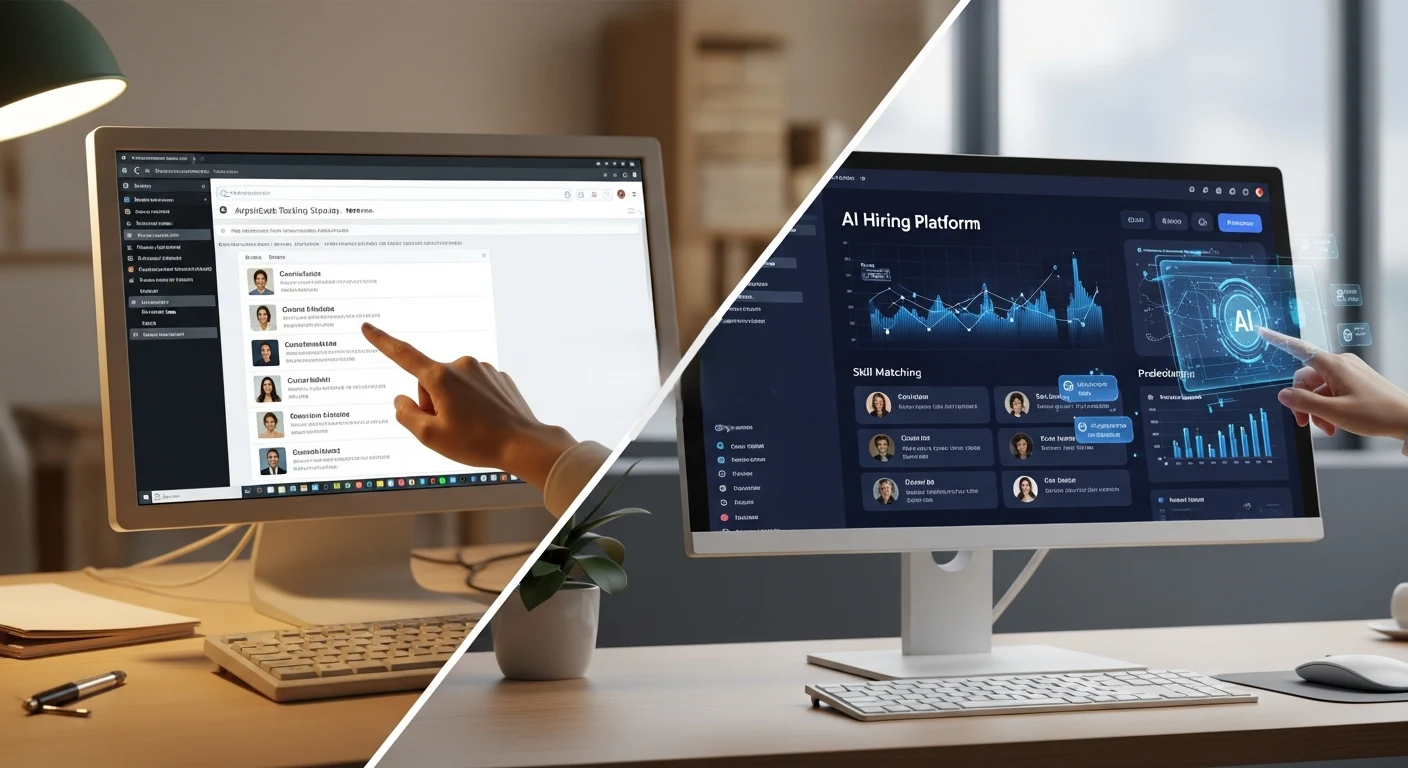
Hiring decisions are often made long before an interview ever takes place. They happen quietly, early in the process, when resumes are reviewed, filtered, and shortlisted. In many organizations, this responsibility still falls on human recruiters scanning dozens or hundreds of applications under tight deadlines. At the same time, AI-driven screening tools are increasingly influencing these early-stage decisions, introducing speed, consistency, and objectivity into a phase historically dominated by manual judgment.
This shift raises a critical question for modern hiring teams: does human screening or AI screening actually produce better hiring outcomes? The answer isn’t about choosing one blindly over the other. It’s about understanding where each approach excels, where each falls short, and how insights from an ATS vs. AI screening comparison can help organizations design evaluation processes that balance human judgment with intelligent automation.
Why This Comparison Matters in Modern Hiring
The debate between human and machine is not just about efficiency; it is about the quality of the workforce you are building. In 2025, the margin for error in early-stage hiring decisions is nonexistent.
Early-stage screening has become one of the most critical and fragile points in the hiring funnel.
Application volumes have surged due to remote work, global talent pools, and simplified application processes. Recruiters are expected to move faster than ever, yet still deliver shortlists that hiring managers trust. Every decision made at this stage shapes interview quality, time-to-fill, and ultimately, quality of hire.
The challenge is that early screening decisions are often made with limited information and under pressure. When mistakes happen here, they’re expensive. Promising candidates are filtered out. Weak matches move forward. Bias creeps in unintentionally. That’s why the comparison between human screening and AI screening matters not as a debate about technology, but as a discussion about outcomes.
Furthermore, this comparison matters because the definition of "good hiring" has evolved. It is no longer just about filling a seat; it is about diversity, retention, and performance. We need to understand if AI screening solutions can strip away the biases that have plagued manual recruitment for a century. By analyzing the mechanics, limitations, and outcomes of both methods, we can finally answer the question: Does AI screening outperform human screening when it matters most?
How Human Screening Works in Practice
Human screening is rooted in experience, intuition, and pattern recognition. Recruiters review resumes, assess relevance, and make judgment calls based on their understanding of roles and organizational needs.
Resume review under time pressure
In theory, human reviewers bring nuance and context to screening. In practice, they often work against the clock. When faced with large volumes of applications, recruiters rely on rapid scanning rather than deep evaluation. This leads to prioritizing easily recognizable signals like job titles, company names, and recent experience.
Heuristics and intuition
Human screening relies heavily on mental shortcuts. These heuristics help recruiters make quick decisions, but they also introduce inconsistency. Two recruiters reviewing the same resume may reach different conclusions based on personal experience or momentary focus.
Where inconsistency enters decisions
Fatigue, workload, and cognitive bias all influence human judgment. Decisions made early in the day may differ from those made late in the afternoon. Over time, this inconsistency affects shortlist quality and makes outcomes harder to defend.
The Limitations of Human-Only Screening
While human judgment is valuable, relying on it alone creates structural challenges. Humans excel at empathy and negotiation; they are poorly designed for data processing at scale. Recognizing the limitations of manual resume screening is essential for any growing organization.
Manual resume screening limitations
Manual screening of resumes has limitations in terms of scalability. The key constraint is bandwidth; there is a hard physical limit to how much text a human can process. As application volume increases, the depth of review decreases. This means that important details may be overlooked simply because there isn't enough time to evaluate each resume carefully.
Cognitive bias and decision fatigue
Recruiter decision fatigue is a real psychological phenomenon. Even experienced recruiters are susceptible to bias. Familiar career paths feel safer. Non-linear backgrounds raise doubts. Over time, decision fatigue pushes reviewers toward conservative choices, reinforcing homogeneity rather than discovering potential.
Scalability challenges
Human screening struggles to maintain consistency across teams, roles, and regions. What one recruiter considers a strong fit, another may overlook. This variability makes hiring outcomes unpredictable.
How AI Evaluates Candidates (And How Decisions Are Explained)
AI-based candidate screening approaches early-stage evaluation from a different perspective.
Rather than relying on intuition or surface-level signals, AI analyzes resumes systematically, applying the same evaluation logic across every candidate.
Pattern recognition over resumes
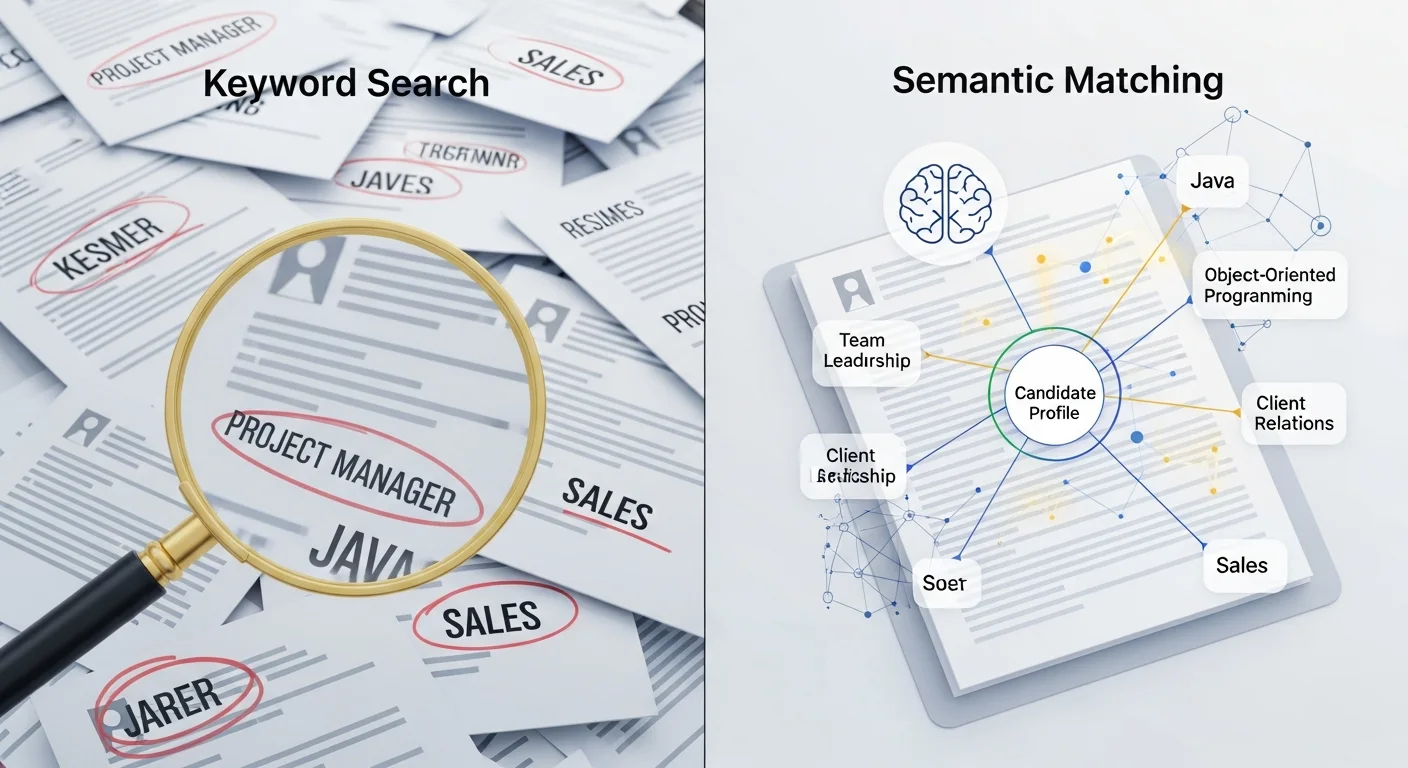
AI looks beyond isolated keywords to identify patterns in experience, responsibilities, and outcomes. It evaluates how skills are applied across contexts, rather than whether specific phrases appear in a resume.AI allows the system to identify candidates with the necessary skills, even when they use different terminology, addressing the "keyword mismatch" problem that limits manual resume screening.
Consistent evaluation logic
Unlike humans, AI does not experience fatigue or shifting attention. Each resume is assessed using the same criteria, creating consistency across large applicant pools. This consistency is a key driver of automated screening accuracy. Structured, skills-based evaluation consistently produces more accurate and fair shortlists than manual resume review because it applies the same criteria to every candidate.
Scalability without compromise
AI screening can handle high volumes without sacrificing depth. This makes it particularly effective in high-growth or high-volume hiring environments where manual review becomes a bottleneck. An AI system can parse, analyze, and rank 1000 resumes in the time it takes a human to read three.
Limitations of AI Screening
AI resume screening significantly improves hiring speed and consistency, especially during early-stage candidate evaluation. However, it is not designed to handle every aspect of the hiring process independently. Understanding where AI screening is less effective helps organizations apply it strategically rather than excessively.
Less Effective for Final-Stage Cultural and Human Decisions
AI screening systems are highly effective at assessing skills, experience, and job relevance. However, they are less capable when evaluating factors that require human context and judgment, such as:
- Cultural alignment
- Leadership potential
- Communication style
- Team dynamics
- Values and behavioral fit
These elements are inherently human and depend on emotional intelligence, situational awareness, and interpersonal interaction; areas where AI has clear limitations.
As a result, AI screening should not be used as a final decision-maker. Its greatest value lies in filtering and prioritizing candidates, allowing recruiters and hiring managers to focus their time on deeper, human-centered evaluation.
Human Screening vs AI Screening Outcomes
When comparing outcomes, three dimensions matter most: speed, accuracy, and fairness.
Does AI screening outperform human screening?
In early-stage candidate screening, yes.
- Speed: Reduces time-to-shortlist by over 90%.
- Accuracy: Minimizes false negatives by identifying qualified candidates often rejected manually.
- Fairness: Applies objective, skills-based evaluation while masking demographic data.
- Cost: Lowers cost-per-screen to fractions of a cent.
Speed and throughput
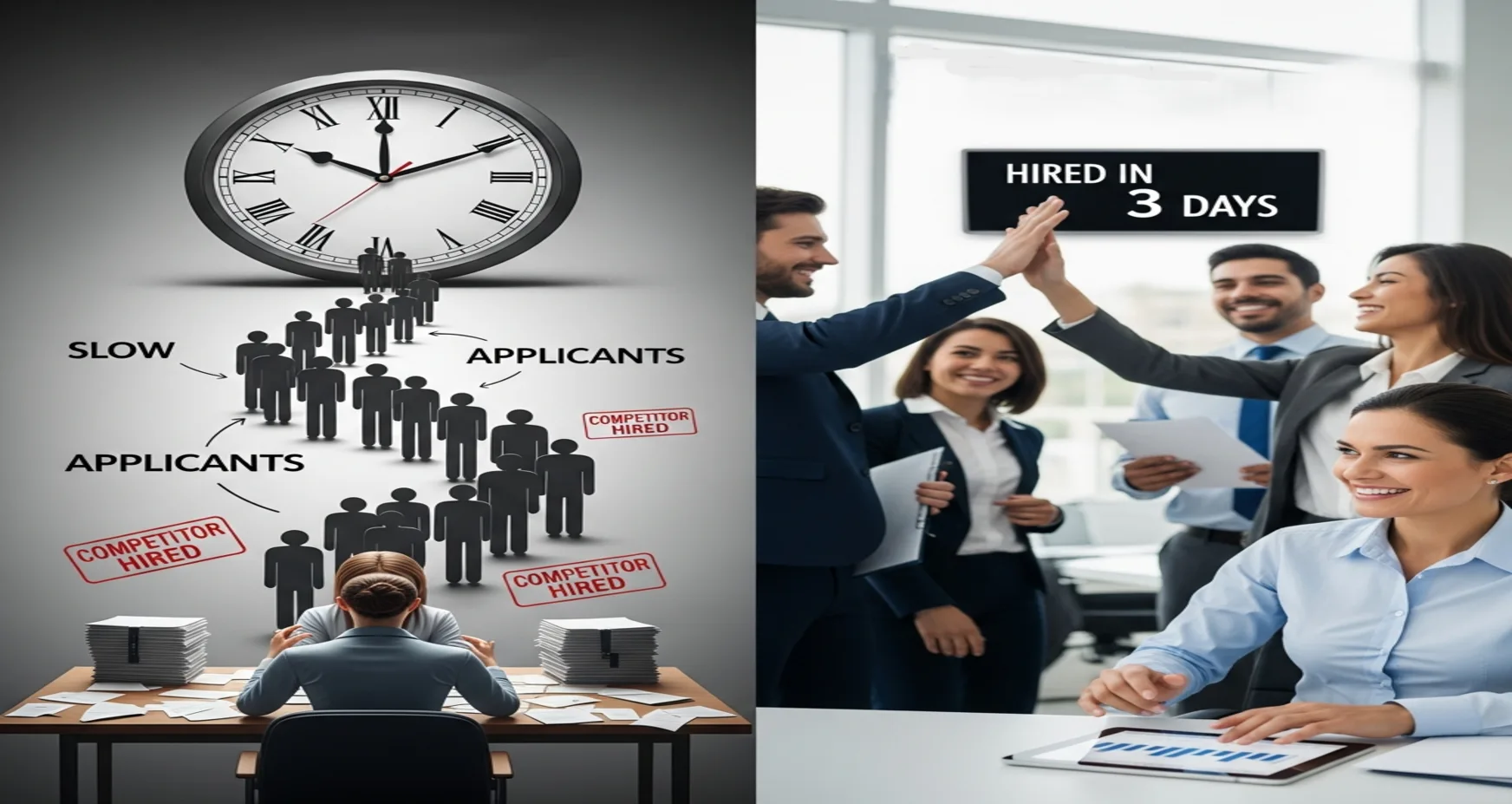
Human screening slows as volume increases. In a market where speed is a competitive advantage, waiting two weeks for a human shortlist is a liability. Speed is the most obvious victory for AI. AI screening maintains speed regardless of scale. This doesn’t just improve efficiency; it allows hiring teams to respond faster to strong candidates, reducing drop-off.
Accuracy and relevance
Human reviewers may overlook relevant experience if it doesn’t match expectations. AI evaluates relevance based on skill alignment and capability, leading to more consistent shortlists. This distinction is central to hiring evaluation objectivity.
Fairness and objectivity
Human decisions are influenced by unconscious bias. AI, when designed responsibly, reduces reliance on proxies like pedigree or familiarity by focusing on role-relevant signals. This directly impacts screening bias in recruitment.
|
Feature / Metric
|
Human Screening
|
AI-Based Screening
|
|
Speed & Throughput
|
Avg. 6–7 seconds per resume (skimming). Can process ~50–100 per day max.
|
Can process 10,000+ resumes in minutes. No bottlenecks during high-volume surges.
|
|
Accuracy & Consistency
|
Prone to recruiter decision fatigue. Criteria shifts based on mood, time of day, and context.
|
Applies the same scoring logic to the 1st and the 5,000th candidate. Never degrades.
|
|
Bias & Fairness
|
Susceptible to unconscious bias (affinity bias, halo effect) and visual triggers
such as names or schools.
|
“Blinded” to demographic data. Evaluates candidates purely on skills and data correlation.
|
|
Depth of Analysis
|
Often limited to keyword spotting and formatting checks due to time pressure.
|
Uses NLP to understand transferable skills, semantic meaning,
and complex experience patterns.
|
|
Scalability
|
Requires hiring more recruiters to handle increasing application volume.
|
Scales instantly up or down without adding headcount or operational cost.
|
|
Best Use Case
|
Final candidate selection, culture fit assessment, and negotiation.
|
Initial high-volume screening, skill verification, and ranking.
|
Bias in Human vs AI Screening
Bias exists in both human and AI systems, but it originates differently. There is a common misconception that AI automates bias. While possible, the comparison of human bias vs AI bias reveals that AI offers a path to correction that humans do not.
Human bias vs AI bias in hiring
Human bias stems from cognitive shortcuts, cultural norms, and personal experience. AI bias, on the other hand, reflects the data and criteria it is trained on. If the training data is skewed, the AI is skewed. However, unlike a human brain, an algorithm can be audited. We can inspect the code, identify the bias, and mathematically correct it. The key difference is visibility.
Where bias originates
Human bias is often invisible and difficult to audit. AI bias can be examined, tested, and corrected because its evaluation logic is explicit. This transparency makes bias easier to address rather than deny.
Why explainability matters
AI screening must be explainable to earn trust. Hiring teams need to understand why candidates are ranked a certain way. Explainability transforms AI from a black box into a decision-support tool rather than a decision-maker.
When Human Judgment Still Matters
Despite its advantages, AI does not replace human judgment entirely.
Human insight is essential in later stages of hiring, where nuance, interpersonal dynamics, and organizational context matter most. There are intangible qualities that AI cannot assess. Cultural alignment, emotional intelligence, genuine passion for the mission, and the ability to navigate complex office politics are human traits that require human assessment and are best assessed through conversation, not automation.
The most effective hiring processes use AI to improve early-stage decisions while preserving human judgment where it adds the most value.
The Hybrid Hiring Model (Best Practice)
The most effective hiring organizations adopt a hybrid model:
- AI anonymizes and parses resumes
- AI scores candidates based on role relevance
- AI produces a structured shortlist
- Humans evaluate context, behavior, and leadership
- Final decisions are made collaboratively
This approach delivers speed, fairness, and quality without compromise.
How AICRUIT Balances Human Insight and AI Intelligence
AICRUIT is built around this balanced approach.
Rather than replacing recruiters, AICRUIT supports them by improving early-stage screening quality. It applies AI-based candidate screening to analyze resumes at a skill level, identifying relevance that manual review often misses.
What sets AICRUIT apart is transparency. Recruiters can see why candidates rank where they do, what skills were identified, and where gaps exist. This clarity empowers better decisions rather than automating them blindly.
By positioning AI as an assistant rather than a replacement, AICRUIT helps hiring teams scale screening without losing control or trust.
Choosing the Right Screening Model for Your Team
There is no single screening model that fits every organization. The right approach depends on context.
So, how do you choose?
- For High-Volume Roles (Customer Service, Sales, Grad Schemes): You must use AI screening for high-volume recruitment. Human screening here is inefficient and unfair due to recruiter decision fatigue.
- For Specialized Technical Roles (Developers, Engineers): Use intelligent screening solutions like AICRUIT to verify hard skills and certifications that generalist recruiters might misunderstand.
- For Executive Search (C-Suite): Rely on human judgment. The volume is low, and the soft skills are paramount.
The most effective model is often a hybrid. AI handles early-stage evaluation and ranking, while humans focus on interviews, judgment, and final decisions. This approach combines efficiency with insight and reduces the risk of poor hiring outcomes.
Conclusion
Human screening and AI screening are not competing philosophies. The battle is not about Man versus Machine; it is about Man plus Machine. They are complementary tools. Human judgment brings empathy, context, and strategic thinking. AI brings consistency, scalability, and objectivity. When used together, they produce better hiring outcomes than either approach alone.
This balance becomes most effective when early-stage evaluation is grounded in unbiased resume screening. By removing subjective signals and focusing initial decisions on skills, experience, and relevance, AI creates a neutral foundation that supports human judgment rather than replacing it. Recruiters step into the process with clearer, fairer shortlists, free from many of the distortions that traditionally shape first impressions.
As hiring continues to evolve, the organizations that succeed will be those that move beyond intuition-only screening and adopt intelligent, transparent systems that support better decisions at scale. The future of hiring isn’t human versus AI; it’s human judgment enhanced by intelligence.