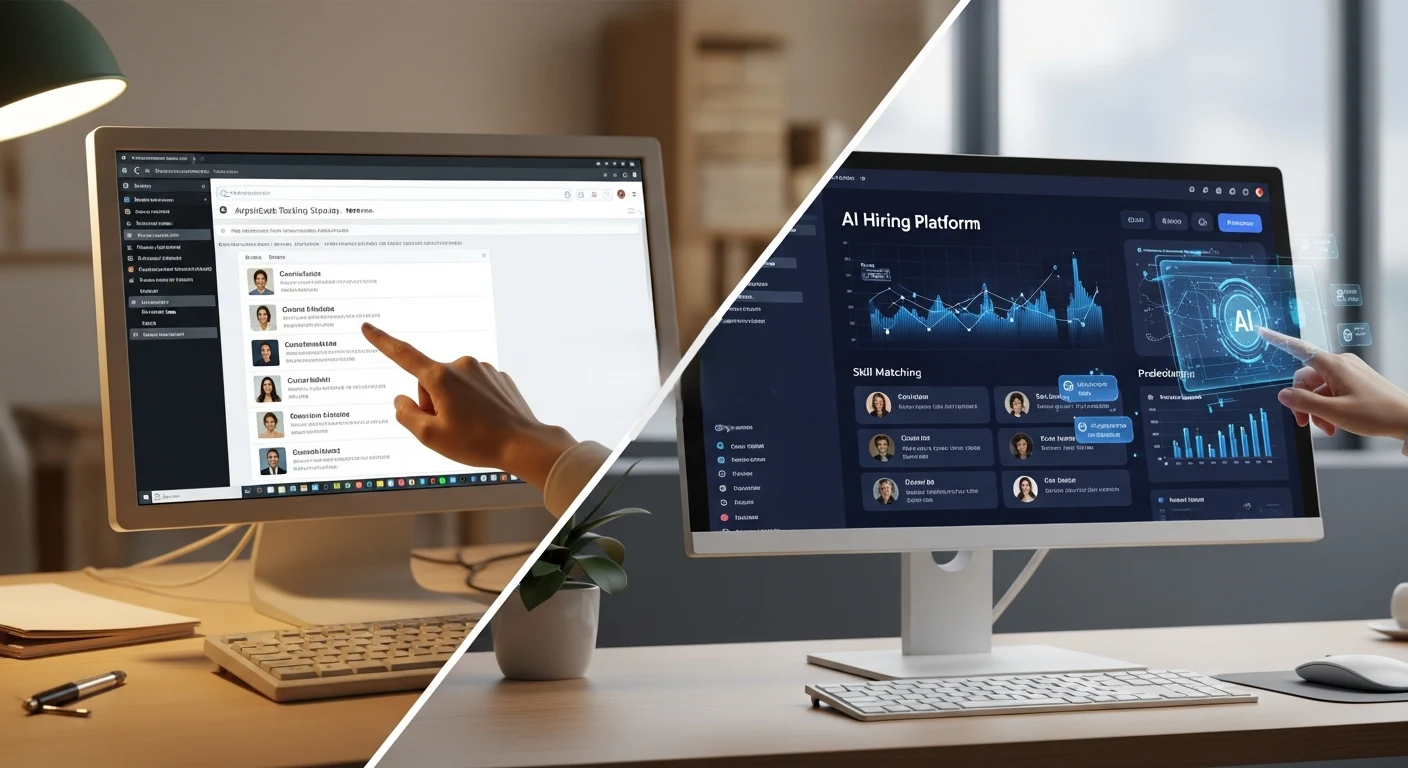
A recruiter logs in on Monday morning and sees it: hundreds of new resumes waiting in the applicant tracking system. The dashboard looks efficient. Filters are ready. Keywords are set. On the surface, everything feels under control. Yet by Friday, the shortlist still feels wrong. Strong candidates slipped through. Interviews didn’t convert. Hiring managers are frustrated. Sound familiar?
This tension sits at the heart of modern recruiting. Hiring teams need speed, but they also need accuracy and fairness, outcomes that traditional systems struggle to deliver at scale. That gap has pushed many organizations to rethink early-stage evaluation through unbiased resume screening, where AI focuses on skills, relevance, and structured signals rather than rigid keyword filters. Against this backdrop, the ATS vs AI screening comparison has moved from curiosity to necessity. Traditional systems were built to manage applicants. AI-driven approaches are built to understand them. The difference matters more than ever.
The comparison isn't about replacing your ATS; it’s about augmenting it. It's about recognizing that the demands of modern hiring, speed, scale, and fairness, require an entirely new layer of intelligence to secure the best talent.
This article breaks down how ATS screening and AI-based screening actually work, where each succeeds, where each fails, and how teams can make smarter decisions without ripping out their existing infrastructure.
Why This Comparison Matters More Than Ever
The friction point between manual processes and business demands has never been greater. The market isn't waiting for you to manually sort through thousands of PDFs. When top talent is off the market in 10 days, every moment spent on ineffective screening is a lost opportunity.
High-volume hiring pressure
Remote work and global talent pools have dramatically increased application volume. A single role can attract candidates from multiple regions, backgrounds, and industries. Recruiters don’t lack effort. They lack time. When screening becomes a race against volume, shortcuts naturally appear. Without scalable, intelligent screening, high volume translates directly into low quality.
This is where early-stage decisions quietly shape outcomes. What gets filtered out never reaches the interview stage. The impact of those early filters echoes through the entire hiring funnel.
Speed without insight
Most hiring tools promise speed. Fewer promise understanding. Traditional applicant tracking systems can process resumes quickly, they filter out candidates who don't have the exact keyword matches, and yes, this is fast. But speed alone doesn’t equal quality. When resumes are filtered without context, recruiters move faster but learn less.
Early-stage screening risks
The earliest stage is the most vulnerable part of the hiring funnel. Bias, inconsistency, and oversimplification tend to creep in when decisions are rushed. This is where qualified candidates are discarded due to arbitrary filters, and where simple errors become expensive mis-hires. If your screening tool relies on rigid rules, it is inherently inflexible to the dynamic nature of skills and career paths. Once a resume is rejected, there’s rarely a second look. That’s why this comparison matters. It’s not about tools. It’s about outcomes.
How Traditional ATS Screening Works
To understand why the ATS falls short on intelligence, we need to know what it was designed to do. An ATS is fundamentally a database built for administration and compliance. Its screening function is based on simple, binary logic. To effectively address the gap, it’s important to start by building a solid understanding of the foundational elements outlined below.
Keyword-based resume filtering
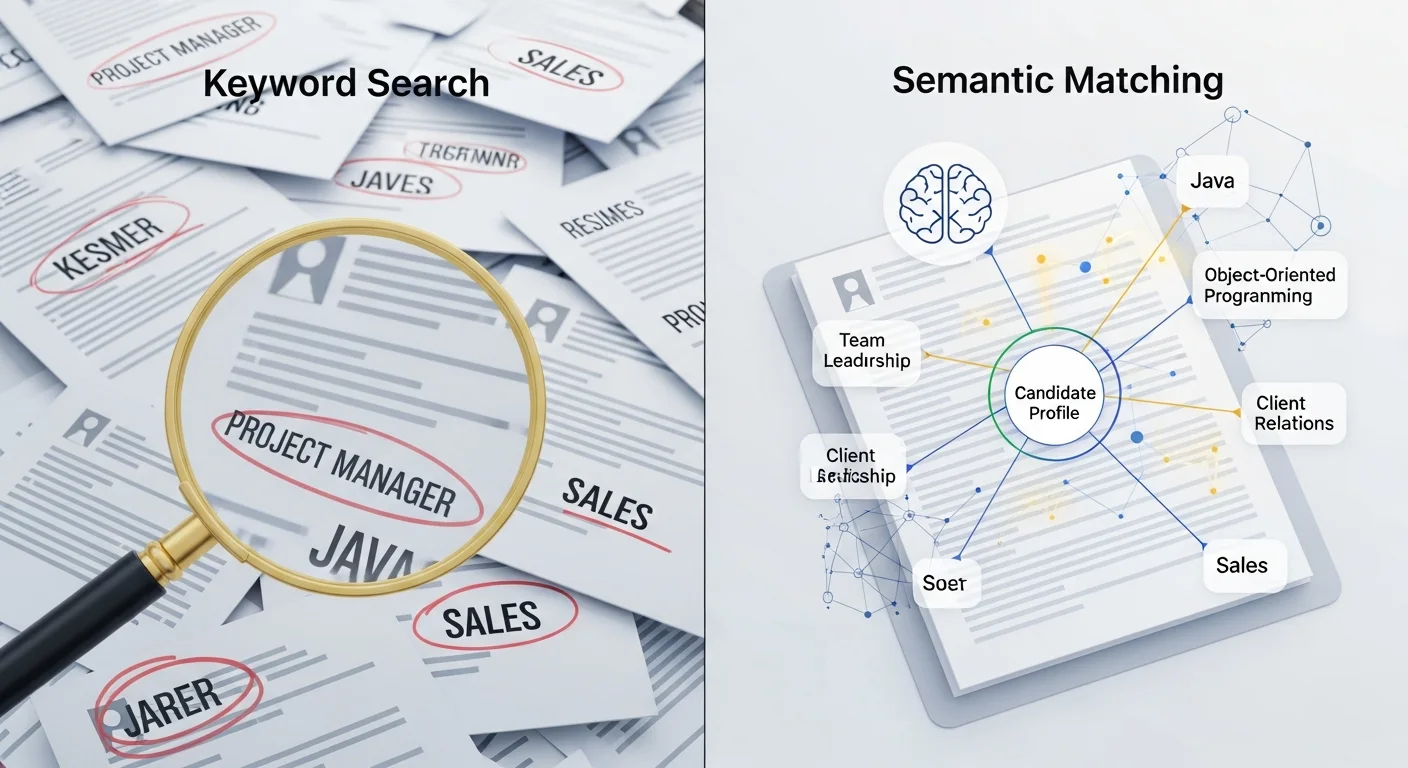
Most applicant tracking systems rely on keyword-based resume filtering. Recruiters define terms, phrases, or must-have criteria. The ATS then acts as a search engine, counting the instances of those exact strings in the resume text. If the resume has the matching keyword, the counter passes; otherwise, it fails. This binary pass/fail approach treats resumes as lists of searchable terms rather than contextual narratives of capability.
This approach feels objective, but it’s narrow. It assumes the “right” candidates describe their experience the same way. In reality, strong candidates often describe skills differently based on industry, geography, or career path.
Rule-driven screening logic
ATS screening follows rigid rules. Years of experience, job titles, education fields, and keyword presence become hard gates. These rules were never designed to evaluate capability. They were designed to organize volume. The ATS can tell you what rules were met; it cannot tell you why a candidate is a good fit.
Resume filtering limitations
The biggest weakness of ATS screening is that it can’t infer. It can’t recognize transferable skills. It can’t evaluate depth. It can’t distinguish between superficial keyword presence and real expertise. It cannot tell the difference between a person who mentions "Excel" once and a person who implemented a global reporting system using "advanced pivot tables" and "VBA." The system struggles with resume filtering limitations because it treats all text equally and fails to detect synonyms, adjacent skills, or transferable competencies. As a result, strong candidates are often excluded for reasons unrelated to performance.
Learn more about: How AI Helps Identify Transferable Skills Hidden in Resumes
How AI-Based Candidate Screening Works Differently
Modern AI candidate screening works using entirely different principles. It approaches the same problem from a completely different angle. It views a resume not as a document to be searched, but as a complex data structure to be interpreted and understood.
Contextual skill interpretation
Instead of scanning for exact matches, AI reads resumes contextually. The heart of AI screening is contextual skill interpretation, driven by Natural Language Processing (NLP). It looks at how skills are used, how responsibilities evolve, and how experience aligns with role requirements. This allows it to recognize capability even when terminology differs.
Automated candidate ranking
Once skills are interpreted and extracted, AI evaluates relevance and ranks candidates accordingly. This ranking isn’t arbitrary. The result is a consistent, unbiased alignment score that ranks every candidate, from 1 to 1,000, based solely on predicted job success factors. It’s based on consistent criteria applied across the entire applicant pool.
Recruiters receive more than just a filtered list of candidates; they gain a prioritized view of talent that is defensible because it relies on data rather than subjective human judgment. This approach significantly reduces the time spent on human review by clearly identifying the candidates who are the best fit for the position.
Objective screening signals
Because AI applies the same evaluation logic to every resume, it removes inconsistency caused by fatigue, time pressure, or subconscious bias. This consistency plays a critical role in improving automated screening accuracy and fairness.
(See also: Human Screening vs. AI Screening)
ATS vs AI Screening: A Direct Comparison
This comparison highlights why relying on the ATS for the decision component of hiring is structurally insufficient for today's market.
- Speed: volume vs insight
ATS systems excel at processing volume. AI systems balance speed with interpretation. While both can move quickly, AI provides insight alongside efficiency. It doesn’t just tell you who passed a filter. It tells you why someone is relevant. - Accuracy: keywords vs capability
Keyword matching assumes that presence equals proficiency. AI evaluates capability. It understands context, experience depth, and skill application. This distinction directly influences shortlist quality and downstream interview success. - Fairness: rigid rules vs objective models
Rigid rules often act as proxies for bias. AI models, when designed responsibly, reduce reliance on proxies by focusing on role-relevant signals. This shift supports fair hiring technology by minimizing subjective filtering at scale.
|
Feature
|
Traditional ATS Screening
|
AI-Based Candidate Screening
|
| Speed |
Fast rejection via binary rules.
|
Fast insight via deep interpretation.
|
| Accuracy |
Low. Depends on exact keyword match.
|
High. Depends on contextual skill alignment.
|
| Fairness |
Low. Rules can perpetuate bias (e.g., degree requirements).
|
High. Uses objective, skills-based evaluation models.
|
| Outcome |
Reduced volume, but potential loss of quality.
|
High-quality, diverse, ranked shortlists.
|
Where ATS and AI Can (and Should) Work Together
The goal is not to ditch your existing tech; it’s to upgrade its cognitive function. The most effective talent acquisition strategies treat the ATS and AI as complementary systems.
ATS should be viewed as the system of record, while AI functions as the system of intelligence. The ATS remains responsible for compliance, candidate data storage, communication tracking, and managing the hiring workflow from offer stages through to final hire. AI acts as an intelligence layer on top of this foundation, performing the cognitive work the ATS was never designed to handle, interpreting resume data, evaluating skills, scoring candidates, and producing ranked shortlists.
Rather than replacing existing infrastructure, forward-thinking organizations are integrating this AI layer directly into their ATS via APIs, preserving long-standing technology investments while immediately upgrading screening capability. Recruiters continue operating within familiar ATS interfaces, but now make decisions informed by AI-driven insights, objective scoring, and automated ranking that traditional systems cannot deliver.
How AICRUIT Elevates Screening Beyond ATS Limitations
AICRUIT was specifically designed to solve the intelligence gap left by traditional ATS platforms. We don't want to replace your filing cabinet; we want to give you an expert researcher who organizes and interprets the data inside it.
We transform the function of screening from basic resume filtering to deep resume understanding. By focusing on interpreting skills contextually, AICRUIT ensures that no high-potential candidate is missed simply because they formatted their resume differently or used an uncommon industry term.
This aligns with the evolution toward intelligent screening solutions that prioritize understanding over filtering.
A Practical Playbook for Choosing the Right Screening Approach
Transitioning to an intelligence-driven model requires a clear, strategic sequence. Use this five-step guide to determine your path forward.
Step 1: Audit Your False Rejections
Review your "Rejected" folder from the last 90 days. If your team is frequently discovering top-tier talent that your keyword filters initially disqualified, your screening limitations are actively costing you talent.
- The Rule: If >15% of your quality hires were originally system-rejected, you have a logic failure.
Step 2: Calculate Your Volume Tipping Point
Identify the threshold where manual review becomes a "skim." When applications exceed 100 per role, human fatigue leads to inconsistent decisions.
- The Rule: Use AI-assisted candidate screening for any high-volume role to maintain 100% evaluation accuracy without increasing headcount.
Step 3: Define Objective Skill Weights
Move away from "years of experience" and toward specific competencies. Map out the critical "Must-Have" skills for your core roles.
- The Rule: If a role requires contextual interpretation of the skills (e.g., complex problem solving vs. simple certification), AI is necessary to see beyond the keywords.
Step 4: Run a Side-by-Side Pilot
Execute a "Shadow Screen." Run one live req through your ATS and the same batch through AICRUIT. Compare the shortlists.
- The Rule: Look for objective screening signals that the AI found that the ATS missed. If the AI shortlist is higher quality and more diverse, the business case is proven.
Step 5: Layer Intelligence, Don't Replace Infrastructure
Finalize your workflow by integrating your AI layer into your ATS via API.
- The Rule: As mentioned above, to make them work together, treat the ATS as your system of record and the AI as your system of intelligence. Feed ranked shortlists back into your existing dashboard to ensure automated candidate ranking happens without changing your team's primary interface
Conclusion: Screening Tools Don’t Hire People, Decisions Do
The most advanced screening tool in the world doesn't hire people; humans do. But the quality of those human decisions is directly dependent on the quality of the information provided.
Modern hiring requires a shift from simple keyword counting to a deeper understanding of skills. To compete for talent in 2025, you cannot afford the blind spots and biases inherent in manual or rule-based screening. The intelligence provided by AI is the difference between simply reducing your list and actually finding your next great hire.
The future of screening is defined by intelligence. By leveraging a comprehensive platform like AICRUIT, you transform your ATS from a filing cabinet into a smart research engine, ensuring your team has the highest quality, most diverse, and best-aligned talent to choose from.